THE MONEY AN INVESTIGATION
Who Gets to Live Here?
Santa Monica, CA built the strongest tenant protections in America. These worked — for 27,668 households, nearly six in ten homes in this city. This is the story of how the same machinery closed the door on everyone else, and why the people who run it still talk like insurgents long after capturing the city.
By the numbers
-
$1,566/mo
Rent gap, pre-1999 tenancy vs today
Source: Rent Control Board medians
-
27,668
Rent-controlled units
of ~47,300 households — nearly 6 in 10
-
117
Ballots cast at the 2024 SMRR convention
effectively chose four of seven councilmembers
-
91%
Share of SMRR's 2026 itemized money from one couple
Source: Form 460, filer 790178
-
$386,039.81
Measure GS loans outstanding
of $387,500; committee has not filed since May 2023
-
6,449 / 471
Units approved vs under construction
Source: City housing dashboard, July 2026
-
~$497M
Unfunded pension liability
Source: City Pension Overview
-
~180
Outstanding abuse claims
Source: Fitch Ratings, October 2025
Contents Introduction
- I. Before the Movement
- II. The Demolition Derby
- III. The Machine That Was Not Quite a Machine
- IV. Pico, and the Limits of a Coalition
- The center
- The lawsuit
- The break
- Progressive for whom?
- Who inherited 1979?
- V. The Record on Development
- VI. How a City Loses Its Zoning Code
- VII. The Landlord
- VIII. Following the Money
- The hollowing
- The loan that was called a gift
- IX. The Bargain Underneath
- X. The Ledger
- The thing that did not happen
- XI. What Happened to the Reform Generation
- XII. Who Won, Who Paid, and Who Was Never in the Room
- XIII. The Best Case for SMRR
- XIV. What the Record Establishes
- XV. What Would Actually Change This
- XVI. Three Dates
- Coda: The Same Evening
- A note on right of reply, and on what this article does not know
The easiest way to see what has happened to Santa Monica is to count what has left.
The Misfit lasted fifteen years. Blue Plate Oysterette, sixteen. True Food Kitchen, fourteen. Walk the Third Street Promenade now and close to a third of the storefronts are dark.

The Third Street Promenade outside the Mann Criterion theatre on 14 June 2009. The marquee advertises films opening on 19 and 26 June that year. The cinema has since closed.
Photograph Balazs Barnucz, CC BY-SA 3.0 Unported, via Wikimedia Commons

The rest doesn’t need a fancy chart to tell the story: the friend who moved to Mar Vista after her building changed hands and the rent jumped; our own grown children, who can’t afford to return to the city where we raised them; the teachers at our schools commuting from Palms and Inglewood because almost no one who works here can afford to live here anymore.
Ask anyone who has lived here twenty years what happened, and the answer arrives in about four seconds. Developers. Sacramento. The market. Whoever we already didn’t like.
This is an attempt to say something more useful and considerably less comfortable.
What happened to Santa Monica was not mostly done to us. We voted for it — at the ballot box, repeatedly, by wide margins, for reasons that were good at the time and that most of us would vote for again. What we did not build is the machinery that grew up around those votes — the endorsement, the convention, the procedures — and most of us have never set foot in it. That machinery is now the reason the city cannot fix what the protections did. And nearly every decision that produced this was made in public, by people we elected, in rooms we could have sat in.
Start with a number that describes almost every renter in this city.
Two of our neighbors can live in the same building, on the same floor, in the same layout, with the same landlord — and one of them pays $1,566 a month more than the other. More than $18,000 a year, for the same square footage behind the same front door. That is the documented median gap between a household that moved in before 1999 and one signing a lease today.
It is not the market. It is the residue of a decision we made together in April 1979.
Which side of that line we each landed on decides most of what matters about living here: whether our parents can stay in the apartments they retired into, whether the person who teaches our kids can live near the school, whether the children who grew up on our block can ever move back to it. We did not hand out that advantage by income, or by need, or by how long anyone had worked. We handed it out by arrival date.
The organization that drew the line is called Santa Monicans for Renters’ Rights — SMRR, pronounced smur. SMRR is not us. It is a dues-paying membership organization in a city of ninety thousand, and many of us have voted for its candidates our whole adult lives without ever being asked to a meeting. It has held a majority on our City Council for most of the past forty-seven years, and six of the seven people sitting on it right now hold its endorsement.
Here is something most of us do not know, and it was never hidden from us. In 2024, 117 people met in the auditorium of Grant Elementary School on a Sunday afternoon and effectively chose four of those seven councilmembers. Not 117 delegates representing anyone. One hundred and seventeen dues-paying members, voting in person, no absentee ballots, in a city of ninety thousand. And in the first half of this year, ninety-one percent of the money that organization raised came from one married couple.
That arrangement built something genuinely rare, and we should say so before we say anything else: Santa Monica has about 47,300 occupied households. Nearly 28,000 of them — close to six in ten, and roughly four out of every five rental homes — pay below-market rent on some of the most valuable coastal land in America. Almost nowhere else in Southern California managed that. It is ours, we did it, and it has kept a great many of our neighbors in their homes.
It is also now under more strain than at any point since we voted it in. The city has declared a state of fiscal distress. The state has taken much of our zoning authority away. And in October a court will decide whether the way we elect our council has, for decades, diluted the votes of our most diverse neighborhood.
All three pressures met in a single vote this summer.
On the evening of July 14, 2026, the Santa Monica City Council voted five to one to begin upzoning single-family neighborhoods.
It was not a concession to developers. It was a maneuver against a state law — and the neighborhood it was designed to protect was Pico, the most racially diverse and historically working-class part of the city.
Thirteen days earlier, Senate Bill 79 had taken effect statewide. Signed by Governor Newsom the previous October after a seven-year campaign by State Senator Scott Wiener, it overrides local zoning within half a mile of major transit stops. Santa Monica has six such zones. The law offered an exit: a city could defer its application until roughly 2030, but only if a third of a zone’s parcels already permitted at least half of what SB 79 would require.
Five of the six zones cleared that bar, because the city’s 2021 housing plan had concentrated capacity on commercial boulevards while leaving residential neighborhoods largely alone. The sixth — around the Expo/Bundy light-rail station on the eastern edge, at Pico’s northern boundary — did not. Only about nineteen percent of its 381 parcels qualified, in part because most of the zone lies across the line in Los Angeles. The city needed roughly fifty-two more parcels permitting more housing.
The parcels available were zoned R1: single-family homes.
So the council directed staff to return with an ordinance upzoning single-family lots — as few as the roughly fifty-two needed, or as many as all 212 — in order to exempt the entire zone.
That was not what the Planning Commission had recommended. The commission voted 7–0 for a different fix: upzoning the sixty-six R2 and R3 parcels in the zone, the multi-unit blocks. Negrete moved to adopt the commission’s recommendation and got no second. Raskin then moved the substitute that passed, and his stated reason was displacement. Rent-controlled buildings in R2 and R3 sit under Ellis Act pressure — the Rent Control Board’s own study found hundreds of units Ellised and left vacant, with no record of what became of them. Single-family parcels, being owner-occupied, hold almost no tenants to displace. His guiding principle, Raskin said, was “to do it in a way that minimizes risk of displacement.”
He also argued the change was close to nominal, and staff agreed. SB 9 and SB 1123 already apply to those lots; on a typical 5,500-square-foot parcel the difference is roughly one or two units. Asked directly whether this was “not effectively just a paper up zone,” planning staff answered: “Yes.”
The vote was 5–1: Zernitskaya, Barry Snell, Ellis Raskin, Dan Hall and Caroline Torosis in favor; Lana Negrete opposed. Jesse Zwick recused himself, citing his employment as Southern California director of the Housing Action Coalition. Negrete, explaining her no vote, said she had wanted the commission’s version: upzoning R1, she argued, “creates a more speculatory process and properties become more vulnerable to be sold by corporate predators.”
That recusal has a documented history, and it is worth setting out precisely, because it has been described inaccurately in circulation.
On December 8, 2025 the Fair Political Practices Commission answered a request for advice — file number A-25-153 — submitted by Santa Monica’s own interim city attorney, Heidi von Tongeln. The commission concluded that there is a “nexus” between Zwick’s paid duties as the Coalition’s Southern California director and city decisions that would “achieve, further or hinder the Coalition’s goal of advocating for housing production,” and that he may not take part in them. It also concluded that nothing required him to resign his seat, and that the city could still enter agreements provided he recused.
Three things that letter is not. It is not a ruling; it is advice, requested by the city about itself. It is not retrospective — “Because we only advise as to future conduct,” the commission wrote, “this letter should not be construed as assistance on any conduct that may have already taken place.” And it is not a finding of fact: the commission stated it is “not a finder of fact when rendering advice,” and that its analysis “assumes your facts are complete and accurate” — those facts having been supplied by the city. It made no finding that Zwick did anything improper, and it declined to advise on decisions for which it was given no facts.
The facts the city supplied run largely in his favor, and they belong here. Zwick told the Coalition at the outset that he would do no work in or relating to Santa Monica, and the Coalition agreed to exclude the city from his portfolio as a condition of employment. He draws a fixed salary with no commissions, bonuses or performance incentives. He has no direct reports and does not report to either of the organization’s boards. The Coalition confirmed it has ceased advocacy in the city altogether.
One question the commission raised and then expressly set aside. In declining to address past conduct it named a specific category: “any prior involvement in the housing production decisions the official may have engaged in while negotiating prospective employment,” citing Government Code section 87407, which bars an official from participating in a decision directly relating to a person with whom they are negotiating employment. The commission did not say whether that category captures anything here, because it does not opine on the past.
What the record does establish is a sequence. On August 12, 2025 the council adopted the Affordable Housing Production Program pilot; the letter records that Zwick voted for it, and that Corey Smith, the Coalition’s executive director, spoke in favor of it at that meeting. August 12 is also the date from which the Coalition says it ceased all advocacy in Santa Monica. Zwick accepted the Coalition’s offer six days later, on August 18, and began work on September 8, reporting directly to Smith.
Open. When employment negotiations began. The record fixes the acceptance and start dates but not the opening of discussions, and section 87407 turns on that date rather than on the hiring date. Nothing in the FPPC letter or in the city’s account answers it, and no adverse conclusion should be drawn from the sequence alone. The city has since moved to re-ratify three housing votes — August 12, September 9 and September 30, 2025 — which it characterises as precautionary.
The case for it was serious and made by people with standing to make it. Commissioner Leslie Lambert had warned that automatic implementation would raise “serious fair housing issues because of its impact on the Pico Neighborhood” — the area the city’s own housing element identifies as carrying the highest displacement risk and the highest concentration of lower-income residents and people of color. Roughly 856 Pico parcels sit inside a transit zone; about 545 could be redeveloped under the new law. The rest are shielded because they hold rent-controlled apartments, deed-restricted affordable units, or historic designations.
So one description of July 14 is this: a council protected a vulnerable neighborhood from a blunt state law, using the only lever the law provided.
Another is this: a movement founded to protect renters voted to add housing to homeowners’ neighborhoods in order to keep it out of renters’ neighborhoods, and did so to defer, until 2030, a statute whose purpose is to make more housing available to renters.
A third is the one this article is about. Twelve weeks after that vote, on October 26, a Los Angeles Superior Court will begin a trial to determine whether Santa Monica’s method of electing that council unlawfully dilutes the votes of the very neighborhood the council said it was protecting. Eight days after the trial begins, the city votes. Negrete, the lone dissenter that night, is also the only sitting councilmember SMRR declined to endorse.
Santa Monica built the strongest tenant protections in America, and they worked.
That is where an honest account has to begin, and neither camp in this city’s long argument likes to start there — one side because it concedes too much, the other because of what follows.
What follows is that the protection and the closure are not two policies. They are one policy, seen from inside and from outside. The endorsement, the convention, the veto points, the forty-seven years of practice at stopping things — none of which has ever appeared on any ballot — are what held those rents down for six in ten of us, and what made this a city almost no one new can enter. A market-rate studio now takes an income near $115,000. Our children cannot come home.
So this is not the story of a movement that betrayed its principles, and it is not the story of one that failed. SMRR did neither, and the evidence against both charges is stronger than its critics know. It is the story of a movement that kept its principles, completely, for forty-seven years — and of what keeping them cost people who were not yet here to vote.
The same story plays out at every stage of this city’s modern history. Someone pursued a defensible goal through a mechanism that ended up rewarding somebody else. Urban renewal was going to clear blight, and it destroyed the city’s Black neighborhood. Rent control was going to protect tenants, and it produced a city almost no new tenant can enter. Slow growth was going to preserve neighborhoods, and it helped summon the state authority that overrode them. The builder’s remedy was going to force housing, and it produced a portfolio of approvals that were sold rather than built. SB 79 was going to add homes near transit, and it produced a council vote to add homes to single-family blocks instead.
Good intentions, bad outcomes — repeatedly, in every direction, by people who mostly meant what they said.
And the ones who will ask for our votes in November are the ones who still talk about themselves as insurgents, long after they captured the city.
I. Before the Movement
The grievance that produced Pico’s lawsuit is older than SMRR, and any honest account has to begin there, because it means the neighborhood’s complaint is not fundamentally about rent control.
Santa Monica once held the oldest African American beachside settlement in the region. Black families clustered around Phillips Chapel, in the Belmar Triangle near Fourth Street and Pico Boulevard, and north of Santa Monica High School. Bay Street Beach was one of the few stretches of Southern California coast where Black families could swim without harassment. La Bonita, a bathhouse catering to people of color, opened on Pico by 1914.
Beginning in the 1950s, the city took it apart.
Under a federally funded urban-renewal program the city called Build America Better, Santa Monica condemned the Belmar Triangle. Shotgun houses were burned in 1953. The land became, in substantial part, a parking lot for the Santa Monica Civic Auditorium. In 1957 the city adopted its first master plan, and the route chosen for the Santa Monica Freeway ran directly through majority-minority residential Pico. When Interstate 10 was completed in 1964, it had cut the neighborhood in half and removed something on the order of five to six hundred homes and businesses. Estimates of displaced families run past six hundred, nearly all of them Black. The city’s Black population fell by more than half.
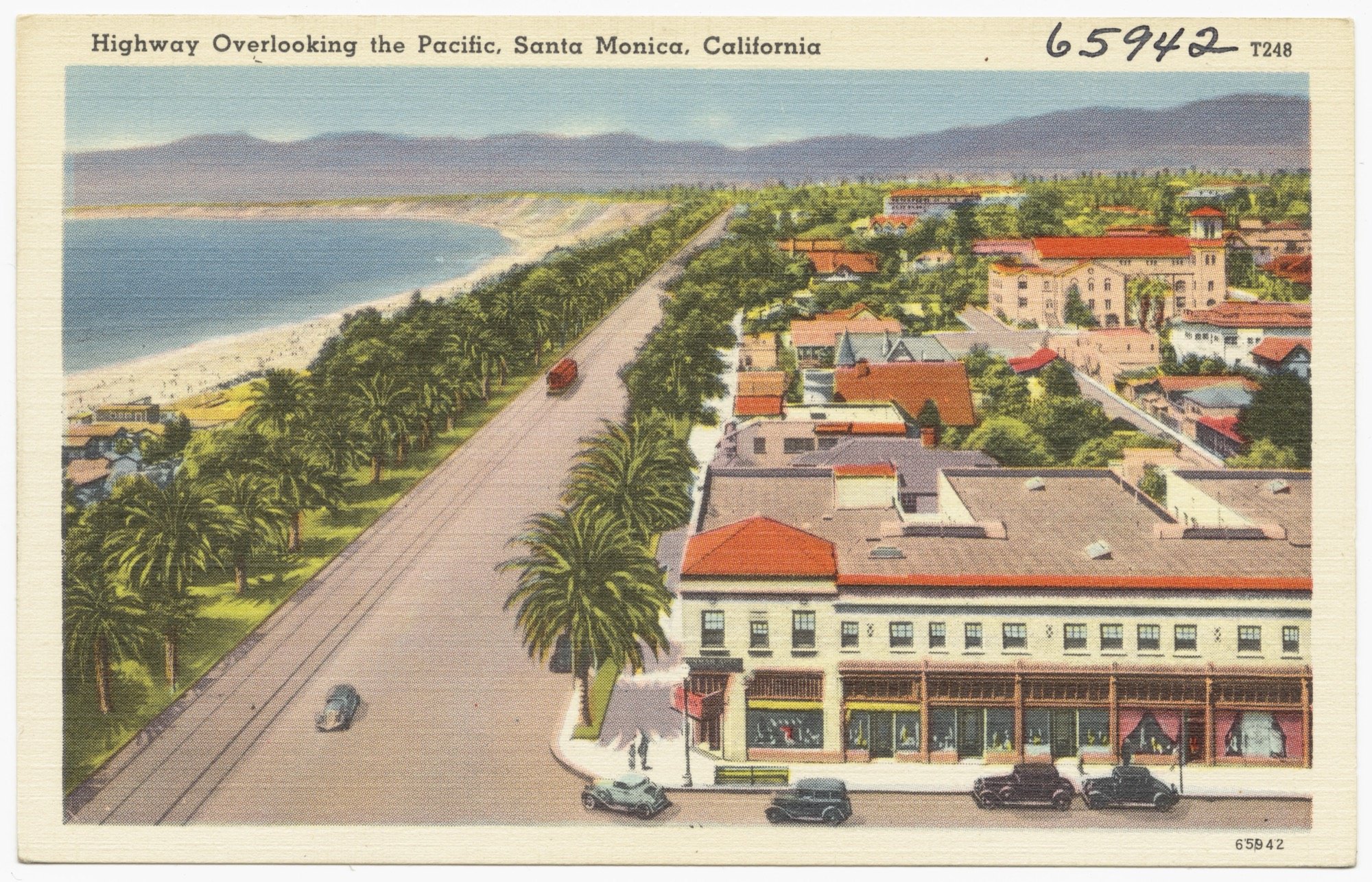
A commercially printed linen postcard of Santa Monica, published by Tichnor Brothers as card number 65942 between about 1930 and 1945 — the city as the tourist trade advertised it, decades before rent control.
Postcard by Tichnor Brothers, Boston, public domain, no known copyright restrictions, via Boston Public Library
.jpg)
In 2021 the City of Santa Monica formally apologized, acknowledging that it “targeted neighborhoods of color for condemnation” and that Black residents “thriving in the Belmar Triangle had homes and businesses condemned and taken away by eminent domain.” It named a new park Historic Belmar Park and created a right-of-return preference in affordable housing for households displaced by urban renewal and the freeway.
Two features of this history matter for everything that follows.
The first is that it produced a geography. Pico today is the part of Santa Monica that lives beside an interstate, with the air quality, noise, and industrial and service land uses that come with it. That is not an accident of the market. It is the residue of decisions made by a city government.
The second is that all of it happened before SMRR existed. So did Santa Monica’s at-large election system, which dates to the 1946 charter. The renters’ movement did not build the structure Pico now challenges. It inherited it — and then became the most successful operator that structure has ever had.
II. The Demolition Derby
By the late 1970s a different displacement was under way, and this one had a constituency capable of organizing against it.
Santa Monica was a compact renter city — roughly three-quarters of residents rented — sitting on land made newly valuable by the beach, the freeway, and the expanding economy of West Los Angeles. Older apartment buildings in Ocean Park and elsewhere were being cleared for condominiums. Between 1977 and 1979, contemporary accounts put the number of rental homes demolished or converted above two thousand. Court records later described more than 1,300 units removed in a single fifteen-month stretch, with the rental vacancy rate near 1.7 percent. Median household income citywide was $11,088.
Residents called it the Demolition Derby.
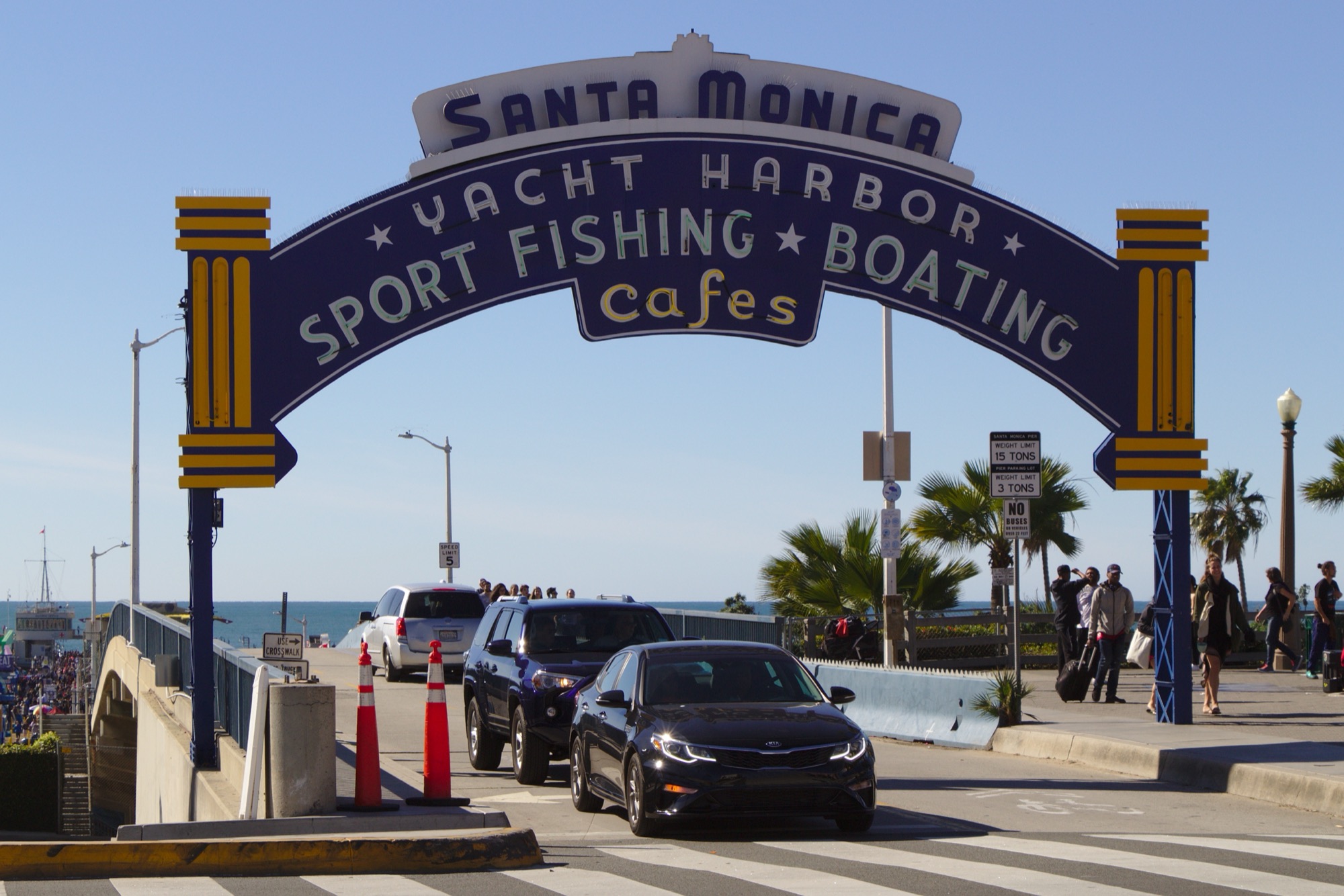
The neon arch over the entrance to the Santa Monica Pier, reading “Santa Monica Yacht Harbor — Sport Fishing, Boating, Cafes”. Photographed in January 2019.
Photograph by John Salatas, CC BY-SA 4.0, via Wikimedia Commons

The tenants had the arithmetic of a majority and none of the habits of power. Elections were held in odd-year Aprils, when turnout could sink toward twenty percent. Many affected tenants were elderly; some did not know whether their blocks belonged to Santa Monica or to Los Angeles.
The movement did not begin with organizers. It began with elderly women complaining about rent increases to the city’s Housing Commission. A commissioner named Syd Rose, a labor lawyer, recruited Robert Myers — a young Legal Aid attorney — to draft a rent-control charter amendment. The seniors ran the petition drive themselves. Only then did the effort meet the second current: organizers trained in Tom Hayden’s 1976 Senate campaign and Ruth Yannatta Goldway’s 1977 Assembly run, among them Denny Zane and a young strategist named Parke Skelton. The seniors supplied urgency and moral standing. The organizers supplied technique.
The first measure lost in June 1978 — the same day California passed Proposition 13. Landlords substantially outspent the tenant campaign and promised that property-tax savings would flow through to renters. The measure also covered small owner-occupied buildings, which drove homeowners into opposition.
It failed. The savings did not flow through.
That fall, activists met in the living room of the Reverend Jim Conn and then in a bookstore, and formed Santa Monicans for Renters’ Rights: a federation of the Democratic Club, the local Campaign for Economic Democracy chapter that Hayden and Jane Fonda had built, the Fair Housing Alliance, senior activists, tenant organizers, and legal advocates.
The second attempt was shrewder. It exempted small owner-occupied buildings. Volunteers raised money through dances at Conn’s church — the Boogie Strategy — and paired it with targeted mail and precinct work. On April 10, 1979, Proposition A passed 54.3 to 45.6 percent, creating one of the strictest rent-control regimes in the country, strict vacancy control, and a separately elected Rent Control Board. Two months later SMRR swept all five board seats from a field of sixty-four candidates. In 1981 it won all four open council seats. Goldway became mayor. Myers, who had drafted the amendment, became city attorney.
This was the optimistic face of late-twentieth-century American progressivism: post-Watergate distrust of established authority joined to the participatory energy of civil rights, feminism, environmentalism, and consumer politics. Its central conviction was that concentrated private power could be checked if ordinary people were given procedural tools — disclosure, review, participation, the vote — and standing to use them.
SMRR’s achievement was not merely a statute. It changed who counted as a political subject. A tenant did not need property to have standing in the city.
III. The Machine That Was Not Quite a Machine
Political scientists have a word for an organization that dominates a city across generations. Machine is the wrong one here, and the distinction determines what kind of accountability is even possible.
SMRR has never had the discipline the word implies. Bill Jennings, one of the first two councilmembers it elected, broke with it within two years. Rent Board members turned on it by 1990, accusing it of valuing politics above low-cost housing. Paul Rosenstein won re-election as an independent in 1996. Pam O’Connor and Terry O’Day held seats without reliably carrying the endorsement.
Nor has it ruled continuously. Goldway lost re-election in 1983. In 1984 the organization’s fourth candidate, Dolores Press, failed to qualify for the ballot. When SMRR councilmember Ken Edwards died in 1985, a divided council appointed an independent. From roughly 1983 through 1988, SMRR held no working majority — and it was precisely in those years that Santa Monica approved the largest commercial entitlement wave in its modern history.
It has also never been a single no-growth party. Beneath the common interest its name states sit at least five distinct moral projects. One tendency treats security of tenure as the irreducible purpose and counts success in evictions prevented. A second, centered on Community Corporation of Santa Monica, accepts construction that produces permanently affordable homes. A third gives primary weight to neighborhood scale and environmental review. A fourth will bargain with developers for housing, labor agreements, or revenue. And organized labor, particularly UNITE HERE Local 11, can favor hotel and housing construction for the jobs while opposing employers who will not meet its terms.
SMRR’s durability owes much to holding those five together. But there is a cost to that talent that is easy to miss: an organization skilled at containing disagreement can absorb evidence that would otherwise force it to revise. When a project passed, one wing claimed community benefits; when it died, another claimed neighborhood protection. The public identity stayed coherent because internal conflict did the work of digesting contradiction.
What SMRR is, precisely, is a dues-paying membership organization whose endorsement is close to decisive in local elections and whose procedures allow a small number of people to control it.
The mechanics explain almost everything downstream. SMRR is a registered California political committee, filer number 790178. Under bylaws last amended in 2005, endorsement requires 55 percent support at an annual convention. Voting is secret and in person; there are no absentee or mail ballots. Members must have paid dues and joined months before a cutoff. Quorum is fifty-one.
Fifty-one people at 55 percent is twenty-eight votes.
At the 2024 convention, 117 ballots were cast. All four members of the slate that swept that November received at least 100 of them. Co-chair Patricia Hoffman called it possibly the easiest convention the organization had ever held. Four council seats in a city of roughly ninety thousand were effectively allocated by 117 people on a Sunday afternoon.
Nancy Greenstein, a former co-chair, has warned publicly that a threshold that low is vulnerable to organized bloc voting by any faction motivated enough to recruit before the cutoff.
Three advantages made this durable. The first was demographic and self-reinforcing: rent control preserved a renter majority, and the renter majority re-elected rent control’s defenders. The second was structural. In 1984 voters moved municipal elections from low-turnout odd-year Aprils to high-turnout even-year Novembers. A Los Angeles Times retrospective a decade later called it a master political stroke. Both things are true at once — the change expanded participation and it made the renter majority more electorally potent. Democratic inclusion and partisan advantage were the same reform seen from two positions.
The irony arrived in November 2020, when SMRR lost three seats in a presidential November, under precisely the conditions its own reform had engineered.
The third was infrastructure: Skelton’s mail program, Roger Thornton’s voter file and four decades as treasurer, and a farm team running upward through the Rent Board, school board, college board, and commissions. The 2024 slate was drawn entirely from it.
None of this is corrupt. Most of it is what a competent political organization does. But it produced a specific result: the effective selection of officeholders migrated from the general electorate to a membership convention, and the barrier to entry for a challenger became not money — as the last two elections proved decisively — but the endorsement.
IV. Pico, and the Limits of a Coalition
The most serious challenge to SMRR’s claim of inclusive progressivism has never come from a landlord association or a developer. It came from people who called themselves progressives too.
Pico’s argument is about standing: whether a geographically concentrated racial minority can convert neighborhood solidarity into a council seat, or must first assemble a citywide coalition acceptable to Santa Monica’s dominant endorsing organizations.
The question is not new. Latino and Pico activists supported district elections in the 1970s. In 1988, opponents of SMRR floated Proposition J, which would have kept citywide voting but created separately contested seats — its political purpose was partly to break SMRR’s slate advantage, though supporters also invoked minority representation. A 1992 charter commission considered districts and ranked voting, and recorded Pico residents’ sense that their neighborhood had become the city’s repository for undesirable facilities. In 2002, Measure HH — districts bundled with a separately elected mayor, term limits, and runoffs — also failed.
SMRR can point to a real record here. Tony Vazquez won a council seat with its endorsement in 1990, the first Latino candidate to do so in the modern era, and returned in 2012. Oscar de la Torre won five terms on the Santa Monica–Malibu school board with SMRR support. Rent control and affordable housing served many Pico households directly. These were meaningful achievements, and the neighborhood’s critics of SMRR do not generally dispute them.
They did not resolve the structural question.
Defenders of at-large elections make a serious argument. Every councilmember should answer to the whole city. Latino-preferred candidates have repeatedly won. And no plausible Santa Monica district contains anything close to a Latino voting majority — Latino residents were about fourteen percent of the voting-age population when the litigation began. Districts, on this view, would strand most Latino voters outside Pico and convert councilmembers into ward politicians.
Critics answer that a majority-minority district is not the only measure of influence. A Pico-centered district would make candidates organize around neighborhood priorities rather than seek permission from citywide endorsing groups. The machinery that empowered a dispersed renter majority — the slate, the citywide endorsement, at-large plurality voting — can dilute a concentrated community once one organization becomes the dominant slate-maker.
That is the inversion at the center of the dispute. The same electoral structure that let renters overcome a property establishment can make it hard for a racial and geographic minority to elect one of its own. SMRR did not write the 1946 charter. It became that charter’s most effective beneficiary, and thereby acquired an institutional interest in a system its leaders could defend, in good faith, as citywide democracy.
The center
Oscar de la Torre turned a structural argument into a rupture, and his standing in Pico did not begin with his break from SMRR.
After a series of fatal shootings in the late 1990s, he helped create the Pico Youth and Family Center to reach young people conventional institutions had failed. The city supplied substantial funding. The center offered mentoring, arts, employment, and anti-gang programming, and it became a platform for organizing.
By 2012 and 2013, city staff was questioning its governance, accounting controls, fundraising, and compliance with what officials called a last-chance agreement. Nearly a hundred supporters occupied City Hall into the night to defend it. The council continued funding temporarily, conditioned on outside assistance and administrative change. De la Torre offered to resign as executive director. Staff described persistent management deficiencies and argued the center had drifted from direct services toward advocacy. De la Torre and his supporters said bureaucratic objections were being deployed against the city’s only youth organization led and staffed principally by people of color. City funding eventually ended; the center survived on private support.
The episode cannot honestly be reduced to either retaliation or exoneration. The record documents operational concerns, internal conflict, and conditions attached to public money. It does not establish that anyone misappropriated funds, and no finding of that kind was made. It also documents genuine community support and a real disagreement about whether organizing young people to challenge institutions was mission drift or part of serving them.
The political consequence is clearer than the administrative merits. Pico activists saw a progressive City Hall applying a level of suspicion to their institution that better-connected nonprofits escaped. SMRR-aligned officials saw accountability requirements that would apply to any grantee. Each side came to regard the other’s definition of progressivism as self-serving.
The lawsuit
In 2016 the Pico Neighborhood Association and a Latina voter — Maria Loya, de la Torre’s wife — sued the city under the California Voting Rights Act, arguing that at-large elections diluted Latino voting power.
The case has now run a decade and remains unresolved, and its procedural history is worth stating precisely, because both camps in Santa Monica routinely describe it as settled in their favor.
In 2019 the trial court ruled for the plaintiffs and ordered district elections. Plaintiffs sought roughly $22 million in fees under the CVRA’s one-way fee provision. In 2020 the Court of Appeal reversed — the first outright win by a public agency in the statute’s then-twenty-year history. That court held the plaintiffs had not proved dilution, and separately found the record did not establish that Santa Monica adopted at-large elections with discriminatory intent.
On August 24, 2023, the California Supreme Court ruled unanimously that the Court of Appeal had misconstrued the CVRA by applying too restrictive a standard for vote dilution, and sent the case back. It expressly did not decide that Santa Monica had violated the law, and it noted that remedies other than districts — ranked-choice, cumulative, or limited voting — might satisfy the statute. In February 2024 the Court of Appeal returned the case to the trial court.
Trial is scheduled for October 26, 2026.
The city has spent a decade and a great deal of public money defending the system. That defense is legally legitimate and, on the appellate record so far, partly successful. It is also being conducted by a city government in fiscal distress, on behalf of an electoral structure that happens to advantage the organization to which six of seven councilmembers owe their endorsement. Both of those things are true, and neither establishes bad faith.
After de la Torre joined the council in 2020, the council excluded him from confidential discussions of the case, because his wife was a plaintiff and he had been involved with the association. Litigation followed over the exclusion. His supporters called it an effort to silence Pico’s elected voice. The city called it ordinary conflict management in litigation brought by a councilmember’s spouse. Both descriptions capture part of the political reality; the conflict rules supplied the mechanism.
The break
De la Torre’s 2020 alliance with Phil Brock and Christine Parra completed his separation from SMRR, and it confounded the labels. A Latino community organizer and five-term school-board progressive ran alongside candidates whose coalition emphasized policing, business conditions, and homelessness enforcement. By 2024 that alignment drew support from public-safety unions and business-funded committees. Former allies saw apostasy. He saw continuity: an insurgent against an establishment that had stopped listening.
The coalition contained real contradictions, and so did the constituency. Pico residents could favor tenant protection and stronger policing; affordable housing and skepticism toward projects likely to accelerate displacement; racial justice and neighborhood control. Those combinations fit badly into a politics organized around two slates.
De la Torre generated controversies of his own, and his 2024 defeat demonstrated that a claim to represent Pico did not confer a citywide mandate — which is, of course, exactly the plaintiffs’ point about at-large elections. But reducing the dispute to one man’s personality evades the institutional problem he embodied.
Progressive for whom?
By the 2020s, Santa Monica contained at least six organized answers to the question who is missing from the room?
For SMRR, it was the tenant facing a landlord. For Pico activists, a racialized neighborhood facing citywide institutions. For pro-housing groups like Santa Monica Forward and Abundant Santa Monica, the future resident excluded by scarcity. For UNITE HERE, the worker without bargaining power — which made it simultaneously pro-tenant and open to hotels and housing that came with union terms. For the Coalition for a Livable City and Residocracy, the resident facing developers and City Hall, a position that could align with homeowner scarcity. For the 2020 coalition, the ordinary user displaced from a park or a sidewalk by disorder.
Each claim contained truth and a constituency. None could stand in for the whole city.
And the camp that has fought SMRR hardest on development turns out to share its deepest assumption. In July 2026 the architects’ group SM.a.r.t. published a column titled The War Over Who Gets to Decide — an argument, made with real force, that residents have a legitimate claim to influence over their own town and that both capital and ideology are erasing it. Its author named the people being lost: the retiree of thirty years in a rent-controlled unit, the family that bought a small house near the coast before the coast became unaffordable, the renter with no equity but a stake in whether light still reaches the yard.
Every one of them already lives here.
That is not a criticism of the column, which is honest about what it wants. It is an observation about the shape of the entire argument. SMRR and its most persistent slow-growth critics have spent forty years disagreeing about buildings while agreeing completely about the demos. Both define standing as current residence. Neither list includes the household that would move to Santa Monica if a unit existed, because neither camp has any mechanism for hearing from one. The pro-housing groups do speak for that household — and they do it, tellingly, by going to Sacramento rather than to a Santa Monica hearing, because there is no Santa Monica hearing at which such a person has standing to be heard.
The war over who gets to decide has been fought, from the beginning, among people who already had a place to sleep in the city they were deciding about.
Who inherited 1979?
It is worth asking which of these factions actually holds the founders’ politics, because all of them claim to, and the answer is that none of them do — and that this is a fact about Santa Monica rather than a failure of character.
The 1978 founders held a majoritarian position. Renters were roughly three-quarters of the city. Everything about their method followed from that arithmetic: organize the majority, move the elections to November to raise turnout, win at the ballot box, take the institutions and hold them. Derek Shearer’s economic democracy assumed the harmed party was the numerical majority and merely lacked organization. The remedy for powerlessness was participation.
No one in Santa Monica can make that argument now, because no current claimant is a majority.
Pro-housing groups speak for people who do not live in the city and cannot vote in it. Pico’s plaintiffs speak for a community that is roughly fourteen percent of the voting-age population — and their case turns precisely on the fact that being outvoted citywide is the injury. SMRR itself operates a convention where fifty-one people constitute a quorum. The 2020 slate assembled a coalition, won, and was swept out four years later.
This is why every faction has abandoned elections as its primary instrument, and it is the most under-remarked development in Santa Monica politics. The pro-housing movement went to Sacramento. Pico went to court. SMRR went to procedure — a dues cutoff months before the vote, no absentee ballots, a warning to members about outside groups. Three different constituencies, all of whom would once have organized voters, now working through mechanisms that route around the electorate.
Each inherited a fragment of the founding position and discarded the rest. The pro-housing groups took the founders’ constituency logic — that the people most harmed by the housing market have the least say — and inverted their economics, arguing that markets will supply what regulation prevents, which is close to the opposite of what Shearer wrote. Pico’s plaintiffs took the founders’ structural method: change the machinery of election so that the underrepresented can choose their own representative. That is what the 1979 charter amendment did, in a different register, and it makes them the closest thing to a lineal heir the city has — though their claim is racial and geographic where the founders’ was tenurial. The 2020 slate took the insurgent posture without the politics; several of its allies came from the tradition SMRR was formed to defeat. And SMRR retained the founders’ institutions, their constituency, and their vocabulary, while becoming the establishment the vocabulary was built to attack.
There is a sharper way to put the resulting confusion, and it comes from the organization’s slow-growth critics rather than its allies: Santa Monica now has a council that co-sponsors its own preemption. In 2025 the council voted to endorse SB 79 — Lana Negrete, the one member without SMRR’s endorsement, was the only vote against. SMRR itself formally opposed the bill the same year. Then, on July 14, the council that had endorsed the law voted five to one to exempt the city from it. Six of those seven members hold the endorsement of the organization that opposed it. Almost none of that reached a resident except as an outcome.
So when SMRR’s leadership warns its members about outside groups, it is not being cynical. It is using the only language the organization has ever had, in a situation that language no longer describes. The founders were insurgents because they were a majority locked out of a government that a minority controlled. Their successors control the government and describe themselves the same way, and the people now locked out have no majority to organize.
That is the difference between 1979 and 2026, and it is not a difference in sincerity.
SMRR’s historical error was not failing to eliminate disagreement; no coalition could. It was too often treating groups that challenged its hierarchy of harms as defectors from progressivism rather than rival claimants to it. Pico made that weakness visible, because it forced the renters’ movement to confront a form of exclusion rent control could not remedy: exclusion from the power to set the agenda.
V. The Record on Development
The accusation most often made against SMRR is that it presided over a development boom while campaigning against development. The evidence does not support it, and the collapse of that charge is necessary before the real one can be made.
The claim cannot be tested in the form it is usually offered. No decade-by-decade series of market-rate permits from 1979 to 2020 exists in a single primary source. Any superlative about the largest boom in city history is unprovable in either direction. And the phrase conflates different things: commercial square footage entitled, housing units proposed, units permitted, and units completed are four separate series that critics routinely treat as one.
Two facts cut against the charge decisively.
The largest modern commercial wave came during SMRR’s mid-1980s loss of a working majority. A non-SMRR council approved or advanced the Water Garden, the Colorado Place agreement, and major hotels; a 1990 account put the post-1984 entitlement pipeline at roughly 5.8 million square feet, only a portion then built. National credit conditions and office demand supplied the economic force; existing industrial land and staff-negotiated development agreements supplied the mechanism; a non-SMRR council supplied the votes. When SMRR returned in 1988, it inherited vested projects it could constrain but not erase. It downzoned, capped some commercial approvals, and converted the boom into a formative political trauma.
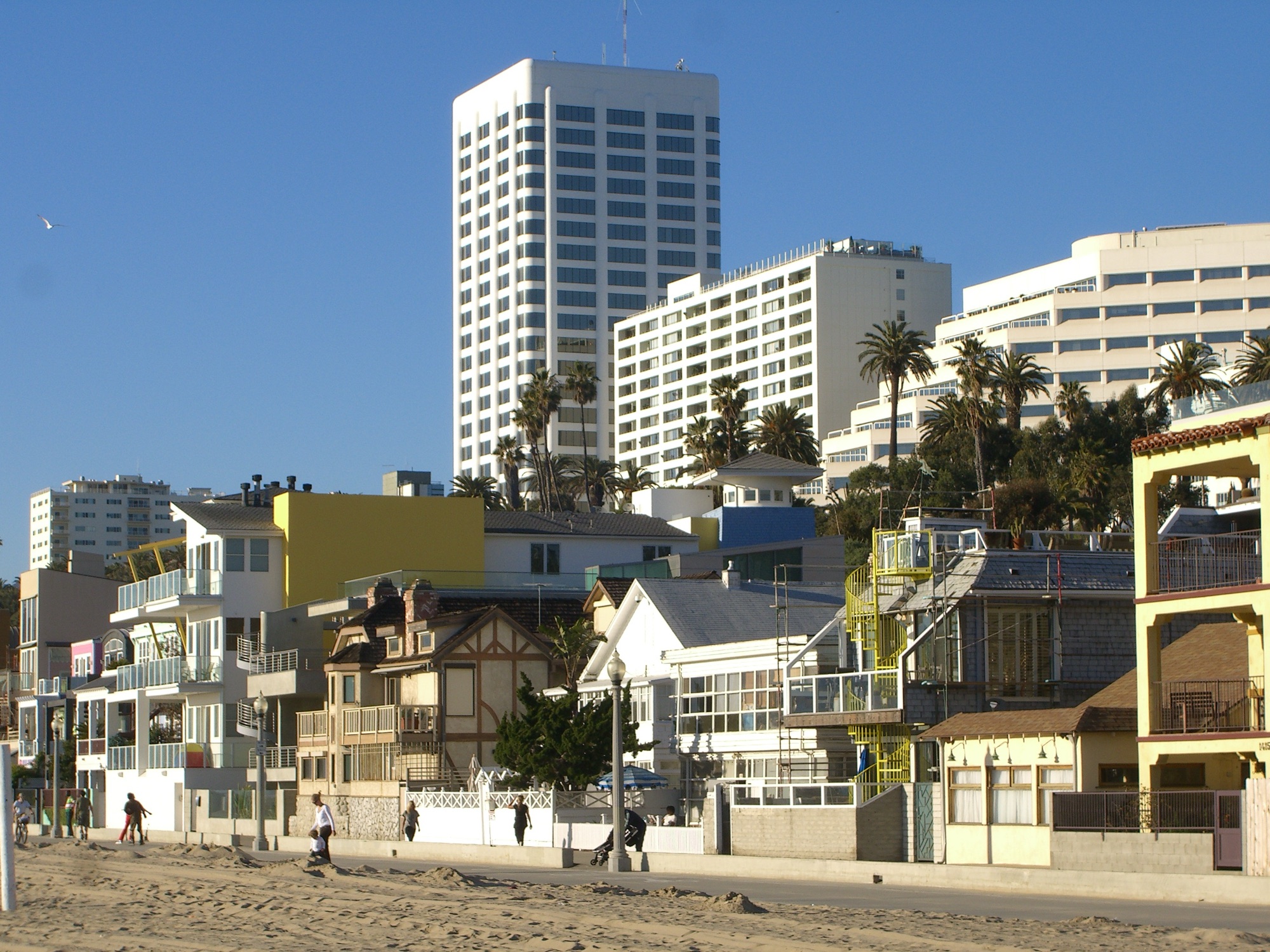
Beach-front houses on Palisades Beach Road below the bluff-top office and hotel towers, photographed 9 February 2008.
Photograph Eric Fredericks, CC BY-SA 2.0 Generic, via Wikimedia Commons (originally Flickr)

And the 2020s wave is largely paperwork. Sixteen projects proposing 4,562 units were filed in 2022. Through the end of 2023, the city had permitted 769 of 2,727 allocated market-rate units and 265 of 6,168 affordable units — 4.3 percent of the affordable target.
Two further facts complicate the picture in the other direction, and they cut against the slow-growth activists rather than for them. In 2008 voters rejected Proposition T, a sweeping commercial-growth limit, roughly 56.5 to 43.5. In 2016 they rejected Measure LV, which would have required voter approval for most projects above specified heights, about 55.3 to 44.7. The median Santa Monica voter has consistently favored rent control, affordability requirements, and limits on large projects, and consistently declined to impose near-total restraints. Santa Monica’s slow-growth politics have generally run ahead of Santa Monica’s slow-growth majority.
And when a council did negotiate a large project, the machinery of the reform era could still stop it. In 2014 the council approved a development agreement for the Hines project at Bergamot; opponents gathered enough referendum signatures that the council repealed its own approval rather than face a vote. SMRR-endorsed officials landed on both sides. It remains the clearest demonstration of where power over development actually sat: not with the council, and not with the developer, but with whoever could organize a signature drive.
So the hypocrisy charge fails. SMRR did not quietly convert. In 2015 an SMRR-era council voted twice, 4–3 each time, to strip Tier 3 — the tallest tier, the one that made larger housing projects possible — out of the boulevard land use designations, and 5–2 to remove activity centers from the land use plan. In 2025 the organization formally opposed SB 79. In 2026 its endorsed council voted to opt out of it.
But the collapse of the hypocrisy charge relocates the question rather than closing it.
Frank Gruber — a former planning commissioner, a longtime civic writer, and, as the filings show, a $515 donor to SMRR as recently as 2022 — makes the strongest version of the case against the organization. He is not an outside opponent; he is an internal dissenter. His argument is that SMRR’s slow-growth politics produced the underbuilding that made state intervention inevitable, so that “Sacramento caused the boom” is true and evasive at once.
SMRR’s answer deserves to be stated at full strength. In the fifth housing cycle, 2013 to 2021, Santa Monica permitted 2,342 market-rate units against a 700-unit allocation and completed 3,643 overall — 185 percent of its total objective. Comparative work assembled for this project places the city’s normalized output broadly near Berkeley: a slow-growth producer among constrained coastal peers, not a singular outlier.
That answer is real, and it is also a statement about the denominator. A city assigned a 700-unit market-rate target was not being asked for much.
The sixth cycle raised the ask roughly fivefold, and here the numbers require care, because the city and its critics count different things and both counts are accurate.
In April 2026 the pro-housing group Abundant Housing LA calculated that Santa Monica had permitted about thirteen percent of its total allocation in the first three years of an eight-year cycle. In July 2026 the city published its own dashboard: 6,449 units approved, 4,082 completed, 2,311 more in the pipeline — and 471 actually under construction.
Both are true. The city counts approvals and completions across the full cycle; the critics count the rate of permitting against the clock. And the affordability split inside the city’s own figures is the part neither side emphasises: of the 2,311 units in the pipeline, 1,944 — eighty-four percent — are above-moderate income. Of the 471 under construction, 343 are. The affordable obligation is 69 percent of the mandate and roughly 16 percent of what is being built.
But the most consequential number in the city’s release is the one City Manager Oliver Chi put in plain language: “Our main challenge now is not the approval of housing projects… Rather, the challenge is the gap between approval and construction, as development costs, financing constraints, and building expenses have stalled market-rate projects across our region.”
Permission is no longer the binding constraint. Capital is. Santa Monica has approved 6,449 homes and is building 471 of them.
On one of those choices the record is now complete, and it is worth setting out in full because it shows the trade being made explicitly, by name, with the losing side saying what they thought was being lost.
On July 25, 2017, the council adopted the Downtown Community Plan. Most of the night’s motions passed seven to nothing. Two did not.
The first reading of the zoning ordinance implementing the plan — the motion carrying the affordability requirements into the code — passed four to three. Sue Himmelrich, Tony Vazquez, Kevin McKeown and Mayor Ted Winterer voted aye. Pam O’Connor, Terry O’Day and Mayor Pro Tem Gleam Davis voted no. Earlier the same evening, Davis had moved to hold the twenty percent inclusionary requirement until the first thousand building permits were issued; that motion failed three to four, the same seven people in the same alignment, reversed.
Himmelrich supplied the amendment that tightened it further, requiring that affordable units be no smaller than the average market-rate unit in a project. It was accepted as friendly.
Those four names are worth holding onto, because they are the same four names, in the same alignment, as the 2015 boulevard downzoning two years earlier.
On the evening of Wednesday, April 15, 2015 — a continued session of the meeting that had opened the night before — the council removed Tier 3 from the Mixed-Use Boulevard designation on a substitute motion by Himmelrich, seconded by Winterer. Himmelrich, Winterer, Vazquez and McKeown voted aye; Davis, O’Day and O’Connor voted no. It then did the same for Mixed-Use Boulevard Low, on a motion by Winterer seconded by McKeown, by the identical 4–3. In between, a stricter version of the second motion failed three to four when Winterer crossed over, and passed only once the staff exceptions were restored.
The same seven people, the same four, the same three, twice in two years — once to take housing capacity off the boulevards, once to raise the affordability requirement downtown. The bloc was not a general one. That same April evening the council split 5–2 on the activity centers and 6–1 on several other items, with Himmelrich alone on the losing side more than once. What held the four together was not a party line. It was a specific and consistent position on how much housing the boulevards should be allowed to carry, and at what price.
The dissenters put their reasoning in the minutes. O’Connor’s recorded explanation for her no vote was that the plan “really is no longer housing plan,” and that the city had sent a signal that “like other cities that have set high affordability standards, really the message is don’t build here.” O’Day stated for the record that he voted no because he thought the policy would “end up being a loss of affordable housing,” and that it was “regressive.”
They may have been wrong. The point is that the choice was not disguised, and it was not imposed from Sacramento. Four councilmembers, three of them SMRR-endorsed, voted to raise the affordability requirement on downtown housing, and three colleagues told them on the record that the result would be less housing of every kind. Nine years later the city has approved 6,449 homes and is building 471.
The defensible conclusion is bounded, and it satisfies neither camp. SMRR materially increased regulatory cost, protected most neighborhoods from substantial change, and repeatedly chose affordability and preservation over maximum production. Those choices constrained supply at the margin. Regional economics, land costs, interest rates, construction costs, coastal geography, and voter preference also mattered, and none of them were SMRR’s doing. If SMRR alone had caused the shortage, removing SMRR would have cured it; the 1980s boom and the 2020 defeat show otherwise. If SMRR had no effect, four decades of downzoning and project resistance were politically meaningless.
VI. How a City Loses Its Zoning Code
The mechanism was bureaucratic and entirely public, and the phrase “the state took over” conceals a sequence of decisions by identifiable people.
Every California city must adopt a state-certified Housing Element. Santa Monica’s sixth-cycle allocation was 8,895 units, 6,168 of them affordable — roughly five times the prior cycle. Gleam Davis described the regime as shifting from a toothless tiger into something with teeth.
The council was openly divided a year before anything failed. In February 2021 Kevin McKeown called the state’s number “real lemons” and put compliance cost at $3.5 to $5 billion. Davis called compliance a moral obligation.
California’s Department of Housing and Community Development rejected the draft on August 30, 2021, and again decisively on February 8, 2022. The letters cited overly optimistic assumptions about the realistic development capacity of inventory sites, accessory-dwelling-unit projections inconsistent with state figures, no specific commitment to allow by-right approvals, and inadequate commitments on city-owned land. Abundant Housing LA and MapCraft Labs concluded independently that claimed capacity might overstate reality by 1,800 to 3,500 homes; that is their analysis, not a state finding.
Because the city was out of compliance, a 1990 statute known as the builder’s remedy activated: Santa Monica could not deny or reduce any housing project setting aside twenty percent affordable units, regardless of zoning.
Was the failure deliberate? The evidence does not establish it, and the outcome argues against it. No memo or contemporaneous statement shows intent, and the result was catastrophic for slow-growth officials, handing developers far more leverage than compliance would have. City Attorney Doug Sloan said the schedule was driven by the state’s review periods rather than city delay. The best-supported reading — an inference, not a finding — is a plan calibrated to minimize required rezoning, reflecting genuine ambivalence about the mandate, that misjudged how much the requirement had changed.
The proximate cause and the background condition are different things, and both are real. Decades of restrictive local politics across California built the coalition for preemption. Santa Monica’s own exposure came from a specific, avoidable certification failure at a moment when such errors had become extraordinarily costly.
The window stayed open roughly eight months. Sixteen applications arrived.
VII. The Landlord
Fourteen of those sixteen came from one company.
Neil Shekhter died on November 23, 2024, at sixty-two. He cannot answer what follows, and this account draws on court records, city complaints, property filings, and trade reporting rather than any interview. His family said he filled their lives with love, humor, curiosity, and never-ending energy. He emigrated from the Soviet Union and founded NMS Properties in 1988.
In December 2016 a Los Angeles Superior Court judge ruled that Shekhter had forged contracts, lied, and destroyed evidence in litigation over a joint venture with the investment firm AEW. The court awarded AEW control of the disputed properties, later sold for roughly $430 million.
In December 2018 the Santa Monica City Attorney filed a misdemeanor criminal complaint against Shekhter’s son Adam, two other individuals, and three affiliated LLCs, over conditions at 1238 and 1242 10th Street. Code Enforcement had been investigating since June 2018. The complaint alleged the defendants disobeyed repeated instructions from Code Enforcement, failed to fully pay for tenants to live elsewhere during renovations, used illegal buyout and eviction notices, operated an unlawful group residential use by renting units bedroom-by-bedroom on separate leases, and maintained a public nuisance by providing substandard housing that lacked a kitchen. More than a dozen tenants had already accepted buyouts since 2016.
The case never reached trial. On July 29, 2022, a Superior Court judge placed Adam Shekhter and three LLCs in a twelve-month pretrial diversion program requiring $102,000 in payments — $80,000 to the city for tenant-protection enforcement and outreach, $20,000 to a former tenant, and $2,000 to a current tenant. Under diversion, the charges are dismissed on completion, and the court retains authority to resume prosecution if the terms are not met.
Adam Shekhter was not convicted of anything. Diversion is not an admission of guilt, and no record of the prosecution resuming has been located.
Two months later, in September 2022, a second judge placed 1433 Euclid Street LLC and WS Communities LLC in a separate pretrial diversion over allegations of price gouging — raising rents 250 percent during a declared state of emergency — requiring $35,000 in payments, posted notices of price restrictions, and tenants’-rights training.
The pattern is worth stating without embellishment, because it is the city’s pattern rather than the landlord’s. Within eight months, two criminal matters against Shekhter-affiliated entities were resolved by payment rather than adjudication. Eight months after that, the city settled the builder’s-remedy litigation with the same family’s company — and that settlement, as later reporting established, also resolved outstanding tenant-harassment claims. Three enforcement actions, three negotiated exits, no finding of liability in any of them.
On September 28, 2021 — four weeks after the state’s first Housing Element rejection — the City and its Rent Control Board sued NMS and an affiliate, alleging that since 2018 the company had invoked the Ellis Act, which permits eviction only if a landlord exits the rental business entirely, to clear the last rent-controlled tenants from two buildings on 10th Street, then illegally re-let those units as vacation rentals and misrepresented the situation to staff. The city’s filing characterized the company’s strategy as acquiring what it called poorly performing multifamily assets — rent-controlled buildings with long-term tenants — to create strong asset value.
Four months later, the builder’s remedy opened, and WS Communities filed fourteen applications.
Filing at that speed required site control and development concepts already assembled. The timing and the portfolio support an inference that the company’s acquisition strategy positioned it to move when the window opened. That is an inference from sequence. It does not establish motive, and the company has not stated one.
Then the entitlements turned out to be the product.
In January 2022 Tishman Speyer paid $150 million for eight entitled sites carrying 627 units. In April 2023 WS listed six more builder’s-remedy projects as a package — “The Santa Monica Six,” 2,930 units and 1.45 million square feet, the largest a fifteen-story, 1,700-unit project on Nebraska Avenue.
This is the part of the episode that deserves more weight than it has received, because it tested a proposition that has organized California housing policy for a decade. The builder’s remedy was the purest available experiment in deregulation: for eight months, in one of the most expensive housing markets in the United States, a developer meeting a single affordability condition could build essentially anything, and no local body could refuse.
What that produced, in the hands of the company best positioned to use it, was not housing. It was a portfolio of tradable approvals — sold once for $150 million, marketed again as a package, and ultimately transferred to lenders when the debt behind them failed. The exemption removed the constraint on permission. It did nothing about the cost of construction, the price of capital, or the incentive to sell an approval rather than pour a foundation.
That does not settle the larger argument about whether new supply reduces rents; researchers have generally found that new construction does soften prices in the blocks around it. But it is direct evidence for a narrower and less comfortable claim: removing local review, by itself, in a market with land values this high and developers this financialized, can produce entitlement speculation rather than construction. Santa Monica’s own dashboard makes the same point without the drama — 6,449 units approved, 471 under construction.
On May 9, 2023, the council voted unanimously to settle: the fourteen-tower slate rescinded in exchange for fast-tracked approval of ten scaled-down versions, revivable if the city reneged.
Subsequent reporting on the company’s finances revealed the settlement did more than resolve zoning. It also resolved outstanding litigation between WS Communities and the city over tenant-harassment allegations.
Santa Monica’s negotiated peace with the landlord it was prosecuting over tenant harassment folded the harassment claims into the same package as the zoning dispute. Whether the city traded enforcement leverage for density concessions is precisely the question, and it cannot be answered from the settlement documents alone. It has not been put to the City Attorney or to the members who voted for it.
The company did not survive its own strategy. When the Federal Reserve raised rates in mid-2022, Shekhter’s largely floating-rate debt reset. By January 2024, WS had signed deeds-in-lieu of foreclosure on twenty-eight buildings and development sites across Los Angeles County, relieving roughly $1.1 billion in unpaid debt — Madison Realty Capital taking twenty properties, Hankey Capital six, Lightstone Capital three. A firm with about 2,200 units in 2020 was down to roughly 1,100. In October 2024 it sold 399 rent-restricted affordable units to Gortikov Capital for $120 million; the buyer subsequently claimed to control twenty-three percent of Santa Monica’s post-1990 affordable inventory.
Six weeks later, Shekhter was dead. The entitlements outlived the company that won them.
VIII. Following the Money
The assumption behind most local criticism of SMRR is that it was captured — that a tenant organization became a developer front. It is wrong, and it is now possible to say so from the documents rather than from inference.
Every campaign finance filing submitted to the City of Santa Monica from 2007 through mid-2026 — every Form 460, 461, 465, 496, and 497 — is published in bulk as transaction-level data. Roughly 45,000 contribution records and 17,000 payment records were analyzed for this article, and every committee total reconciled against that committee’s own summary page.
Two technical hazards are worth recording for anyone repeating the exercise, because both have produced published errors. Filer identification numbers are stored inconsistently across years. And transaction identifiers are unique only within a reporting period, not within a year — in SMRR’s 2013 filings, 122 of 173 identifiers collide. Records must be de-duplicated on content, not identifier, or real transactions disappear.
Real-estate money to SMRR is negligible. Across twenty years, contributions from donors whose stated employer or occupation involves real estate, development, property management, construction, hotels, or architecture total $26,444 — about three percent of itemized fundraising, never above 5.3 percent in any year. The largest names in that category are SMRR’s own: a former SMRR councilmember listed as a real estate marketer, a SMRR-endorsed school board member who is an architect.
Real-estate money to SMRR’s opponents is not. In 2022 the committee opposing Measures GS and DT raised $499,500, including $310,000 from the California Business Roundtable and $120,000 from the California Association of Realtors. In 2024 the anti-SMRR slate committee took $100,000 apiece from Strategic Hotels & Resorts, Edward Thomas Management, Douglas Emmett Properties, and the investor Jerry Greenberg, spending $593,270 against SMRR’s $102,044 — nearly six to one — and losing all four seats. The better-funded side also lost in 2020.
There was also, in 2022, a committee calling itself Santa Monicans for Resident Rights, a name close enough to be mistaken for SMRR’s. It raised $58,600, of which $50,000 came from a single real-estate investor.
One long-repeated claim is false. For years the story has been that only $500 of developer money ever reached SMRR, laundered through a third party by the Huntley Hotel as one of sixty-two counts in an enforcement action that produced a $310,000 penalty in 2017. The Fair Political Practices Commission did not find that any recipient knew the source.
The $500 is real; the filings confirm it, dated June 29, 2013, from the hotel’s general manager. But Huntley-linked sources gave SMRR $14,059 across ten contributions between 2013 and 2024 — including $10,000 on October 24, 2014, twelve days before that election, recorded openly under the hotel’s own name. Disclosed giving in one’s own name is the opposite of laundering, and the $10,000 appears entirely lawful. It also makes the Huntley the fifth-largest single contributor in SMRR’s twenty-year record.
The context is more revealing than the sum. In the same period the Huntley was funding a committee opposing the Fairmont Miramar’s expansion — a competing hotel — with $20,000 in late 2012 and nearly $24,000 in early 2013. It was paying SMRR and the anti-development committee at once. That is not an alliance; it is a hotel hedging a fight about a competitor.
One further detail has gone unreported: Manju Raman, the Huntley general manager identified in the enforcement case as the scheme’s point person, ran for Santa Monica City Council in 2024.
The consultants did not get rich. Across twenty years SMRR paid Parke Skelton’s firm $30,240 — a $5,000 retainer in each of the six election cycles from 2008 through 2018, plus three small reimbursements, and nothing since. In 2016 alone the same firm was paid $75,270 by a single Santa Monica College bond committee. The long-standing claim that he handled SMRR’s mail far below his usual rate is confirmed by the ledger.
So the capture thesis fails at every point where it can be tested. What the filings show instead is something nobody was looking for.
The hollowing
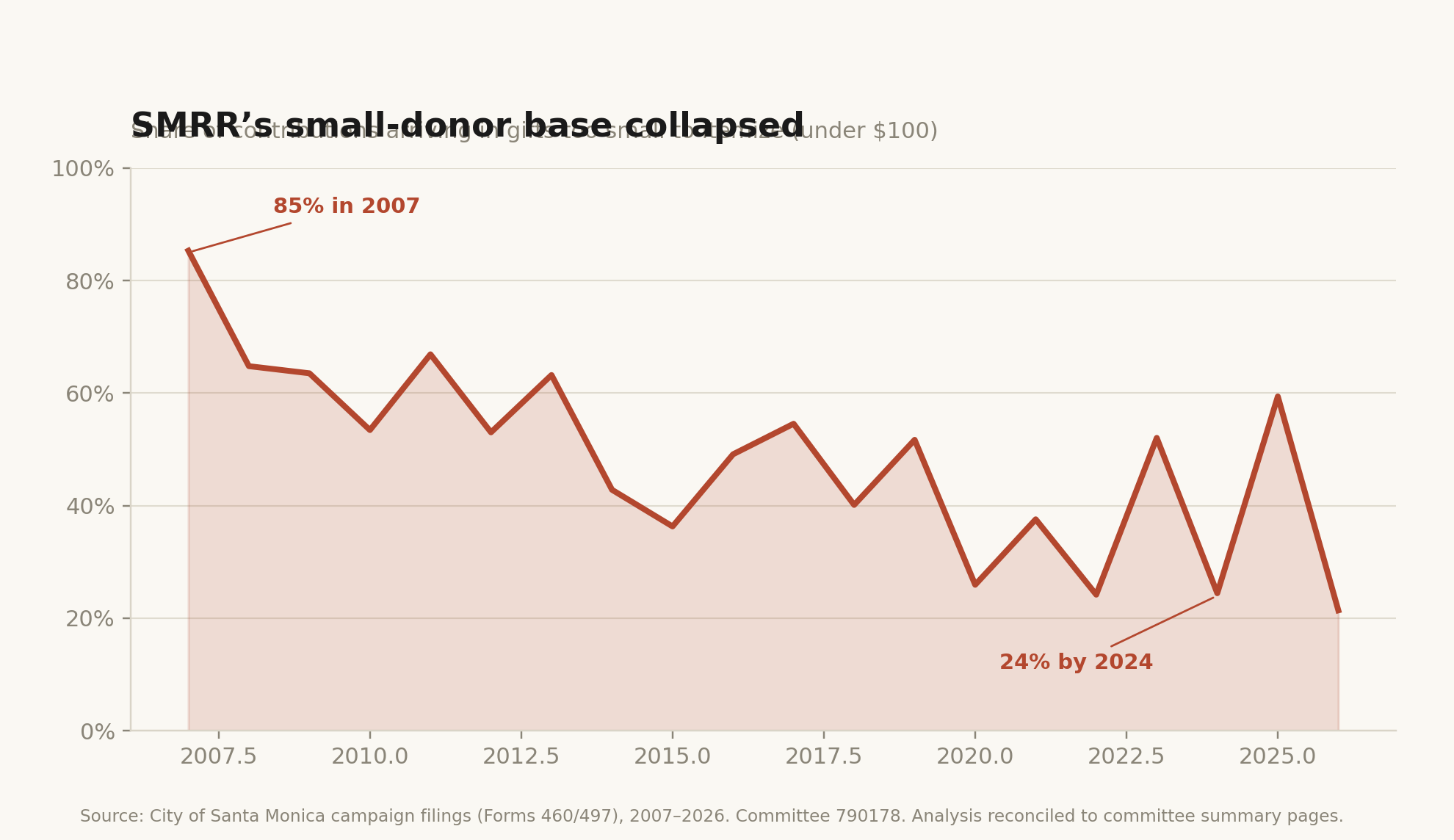
In 2007, eighty-five percent of SMRR’s contributions arrived in gifts too small to itemize — under $100 apiece. By 2024 that share had fallen to twenty-four percent. The small-dollar base that made the organization’s claim to speak for renters credible has thinned by two-thirds.
SMRR's small-donor base collapsed
DV01
Share of SMRR's contributions arriving in gifts too small to itemize — under $100 — fell from 85 percent in 2007 to 24 percent in 2024.
Analysis of City of Santa Monica campaign filings.
What replaced it is concentrated to a degree with no precedent in the record. Michael Soloff, SMRR’s co-chair, has given $113,707 since 2007 — its largest individual donor by a factor of nearly five. His wife, Sue Himmelrich, mayor from 2020 to 2022, has given $31,035. Together the couple accounts for $144,742, or 15.5 percent of every itemized dollar SMRR has raised in twenty years.
The trend accelerates:
| Year | SMRR itemized contributions | From Soloff and Himmelrich | Share |
|---|---|---|---|
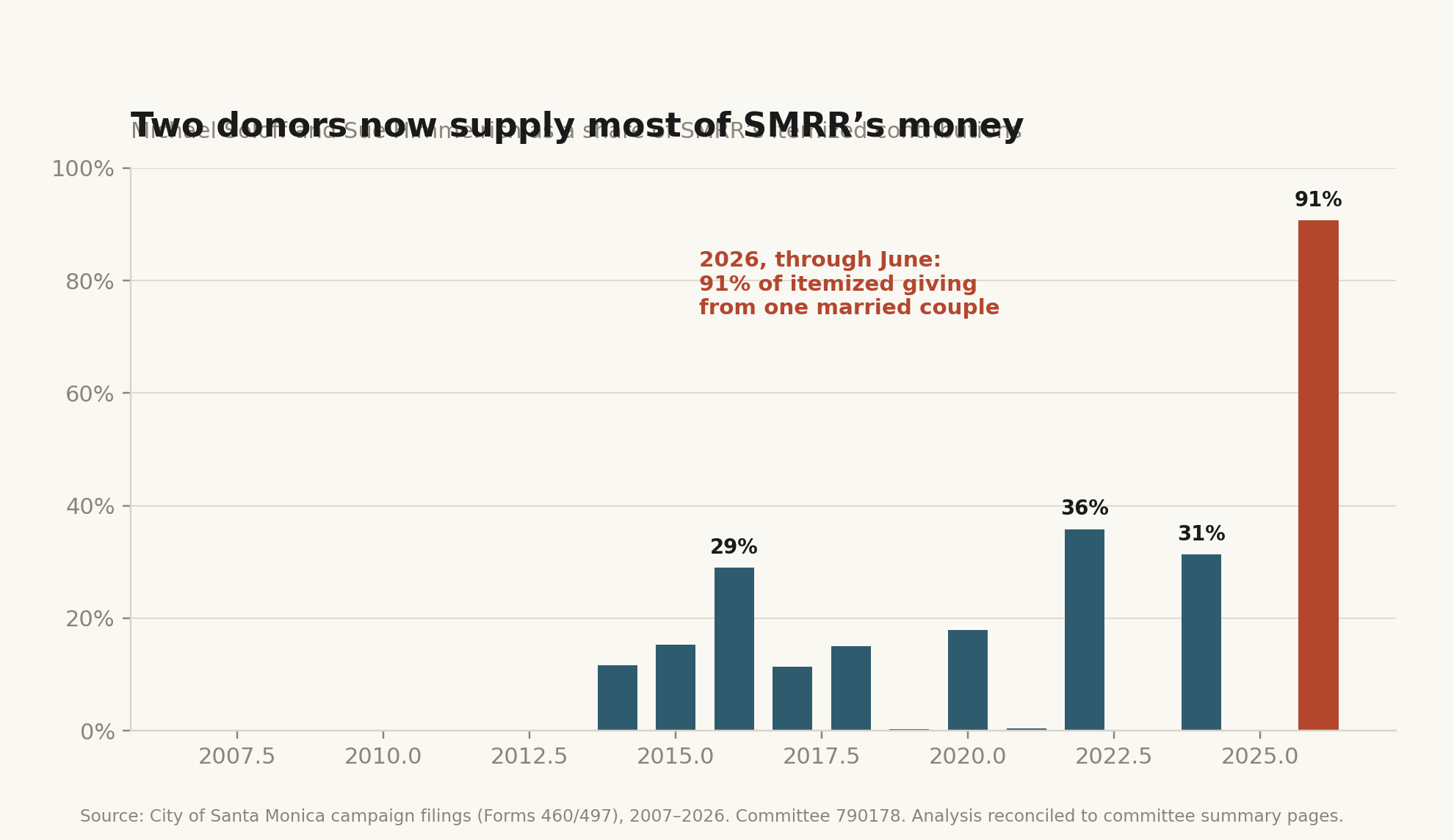
| 2016 | $45,300 | $13,140 | 29% |
| 2020 | $55,810 | $10,000 | 18% |
| 2022 | $69,898 | $25,052 | 36% |
| 2024 | $63,874 | $20,035 | 31% |
| 2026 (through June) | $44,278 | $40,140 | 91% |
Two donors now supply most of SMRR's money
DV02
Michael Soloff, SMRR's co-chair, and Sue Himmelrich, mayor from 2020 to 2022, as a share of the organization's itemized contributions. Through June 2026 the couple supplied 91 percent.
Analysis of City of Santa Monica campaign filings.
Note name variants normalized — Soloff appears under three spellings in the filings, Himmelrich under two.
In the first half of 2026, ninety-one percent of the itemized money raised by Santa Monica’s tenant movement came from one married couple. The organization has also been borrowing from its officers: on November 2, 2022, Soloff and co-founder Denny Zane each lent SMRR $7,500 at zero interest, unpaid through June 2026.
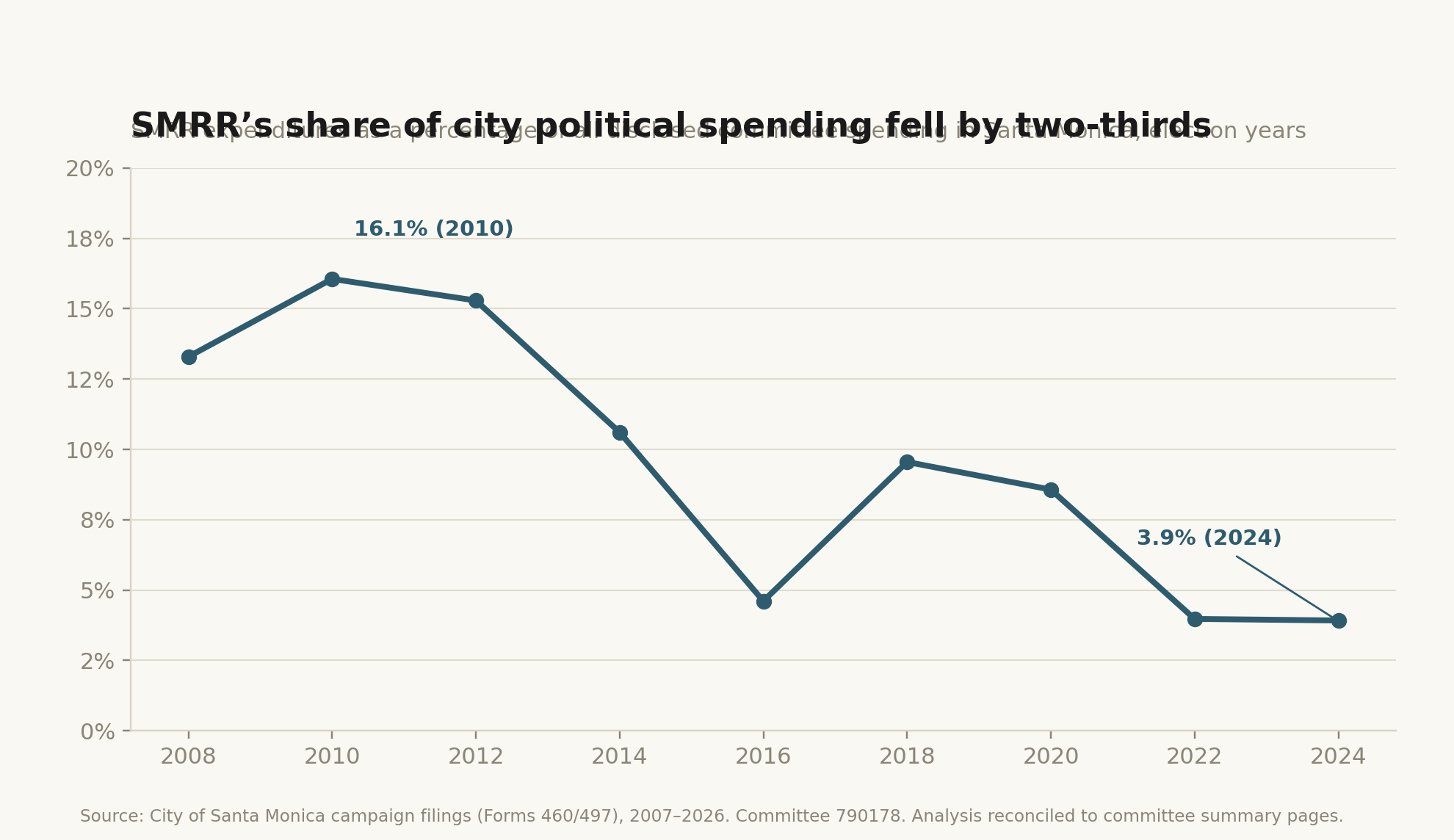
And SMRR’s weight inside its own city has collapsed. It accounted for sixteen percent of all disclosed political spending in Santa Monica in 2010, and under four percent in 2022 and 2024, while total spending roughly doubled.
SMRR's share of city political spending fell by two-thirds
DV03
SMRR's spending as a share of all disclosed committee spending in Santa Monica, election years. The organization commanded 16 percent of the city's political money in 2010 and under 4 percent in 2024.
Analysis of City of Santa Monica campaign filings.
The loan that was called a gift
In 2022 Sue Himmelrich authored Measure GS, a transfer tax on high-value property sales earmarked for homelessness prevention, affordable housing, and schools. It has been reported for four years as the recipient of the largest political contribution in Santa Monica history — roughly $337,500 from Michael Soloff. A recent review of city filings failed to locate any such contribution and concluded the claim was uncorroborated.
It was looking on the wrong schedule.
The committee reported $20,000 in contributions and $387,500 in loans. Between March and December 2022, Soloff made six loans — $50,000, $100,000, $50,000, $35,000, $100,000, and $2,500 — all at zero percent interest. Himmelrich lent $50,000 more. The totals reconcile exactly against the committee’s own summary page. The measure passed.
A loan is not a gift. It is a repayable obligation owed by a political committee to a sitting mayor and to the co-chair of the organization that dominates the council.
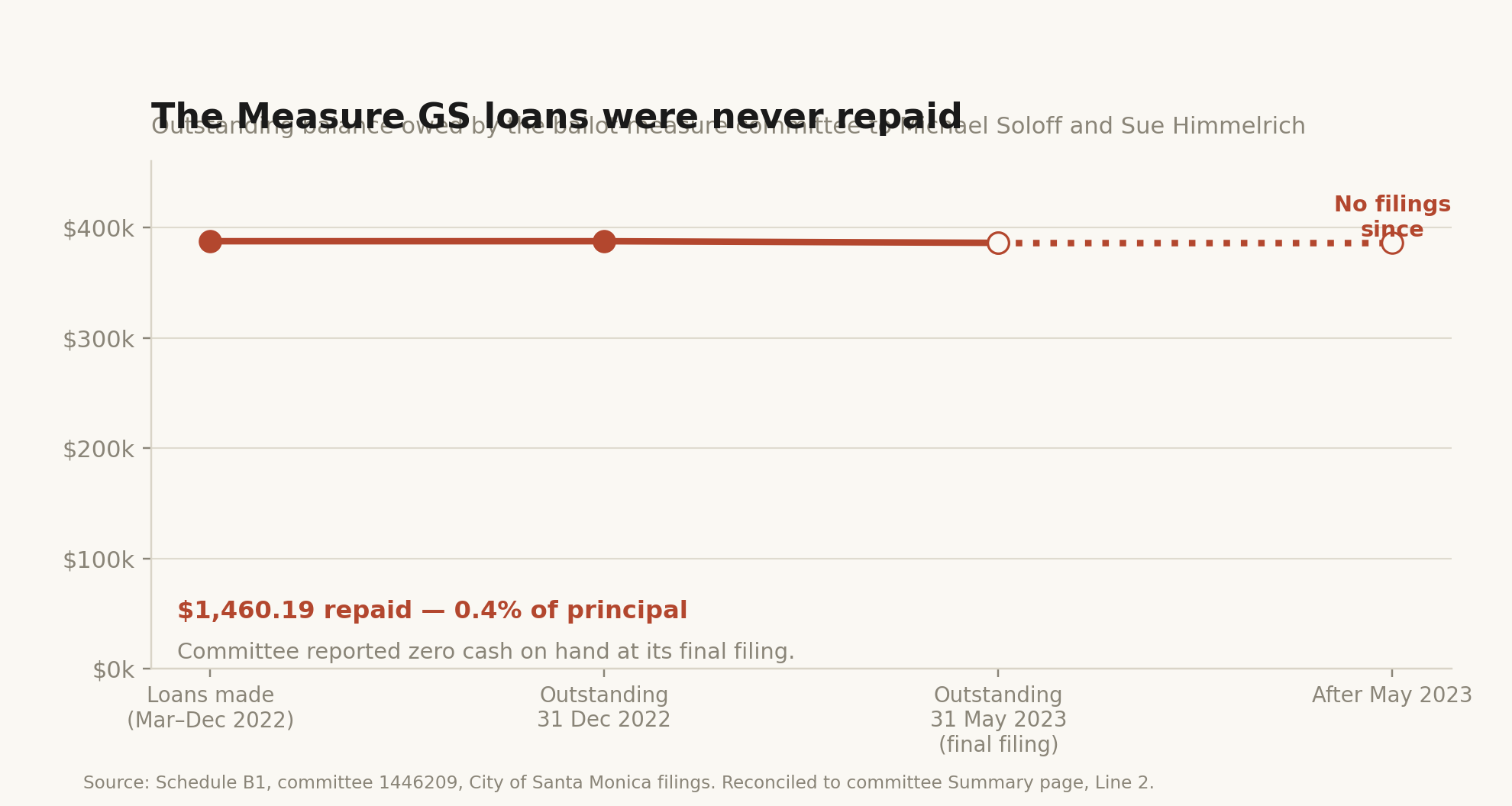
The committee’s final filing covers the period ending May 31, 2023. It reports $386,039.81 still outstanding, zero contributions received that year, and zero cash on hand. Of the original $387,500, exactly $1,460.19 — four-tenths of one percent — was ever repaid. Nothing has been filed in the three years since. There is no termination statement and no successor committee. Under the Political Reform Act a committee carrying outstanding obligations generally cannot terminate, which suggests the filings are delinquent.
The Measure GS loans were never repaid
DV05
Michael Soloff and Sue Himmelrich lent $387,500 at zero interest to the committee supporting Measure GS in 2022. At the committee's final filing, covering the period ending May 31, 2023, $386,039.81 remained outstanding and the committee reported no cash on hand. It has filed nothing since.
Schedule B1, committee 1446209.
Legal note state the facts as filed. Do not characterize the arrangement as a contribution, a gift, or a violation — whether an unrepaid interest-free loan becomes a reportable contribution is an unresolved FPPC question.
The accurate sentence is this: Michael Soloff and Sue Himmelrich lent $387,500 at zero interest to a ballot-measure committee Himmelrich wrote; the measure passed; three years later the committee has no money, has repaid $1,460, and has stopped filing the statements that would disclose what became of the rest.
Whether an unrepaid, unforgiven, interest-free loan to a committee with no assets eventually becomes a reportable contribution is a question for the Fair Political Practices Commission. It has not been asked.
None of this is corruption, and it should not be called that. Every transaction was disclosed. The money advanced a tax on wealthy property sellers. But an organization drawing ninety-one percent of its itemized money from its co-chair and his spouse is not a membership movement in the way it describes itself, whatever the intentions of the people writing the checks.
One more flow. Since 2010, candidate and officeholder committees have transferred $37,138 back to SMRR, peaking in 2018 at twenty percent of its itemized contributions. Legal, common in slate politics — and it means the endorsement carries a financial return to the organization that grants it.
And a coda on the lenders. In 2024 a committee called Restoring Housing Affordability in Santa Monica, sponsored by Local Home Builders, spent $240,312. Its disclosed funders include Madison Realty Capital, which had taken twenty of Neil Shekhter’s buildings, and Hankey Capital, which had taken six. The two firms holding the largest share of Santa Monica’s builder’s-remedy-era real estate were funding city politics within the year. Which candidates the committee supported cannot be determined from its filings, and this article does not characterize its position. But nobody has asked what those lenders wanted.
IX. The Bargain Underneath
There is a question Santa Monica’s housing argument has never had to answer, and it explains more than any land-use vote: how did a city that built almost no housing pay for one of the most generous municipal governments in California?
It ran a trade. Residential growth stayed slow; commercial growth carried the budget. Hotels, offices, tourism, retail, and parking financed parks, libraries, the Big Blue Bus, tenant legal aid, social services, and an environmental program good enough that the city reported greenhouse-gas emissions sixty percent below its 1990 baseline. Residents got the services of a larger city and the density of a smaller one, and the people who paid the difference mostly did not live there.
This was neither secret nor corrupt. It was, for decades, an extremely good deal — and it is why the tradeoffs in this story stayed invisible for a generation. A city that must choose between housing and solvency argues about housing. A city whose hotels cover the gap does not.
The bargain has broken.
The pandemic took 26.8 percent of general fund revenue in a single year. Santa Monica cut spending nearly twenty-four percent and eliminated 299 permanent and 122 temporary positions; services never fully returned. Remote work reduced the daytime population to roughly sixty percent of 2019 levels. Commercial vacancy downtown and on the Third Street Promenade is among the highest in Los Angeles County. Hotel tax has not recovered despite a rate increase.
Then came liabilities of another order. The city has paid more than $230 million in settlements arising from the sexual abuse of children by a former city employee, with $159.6 million drawn from reserves. The exposure is nowhere near closed. Fitch Ratings, revising its outlook in October 2025, cited roughly 180 outstanding claims; the July 14, 2026 closed-session agenda alone lists some three dozen filed suits against the city and the Santa Monica Police Activities League, with new filings continuing into 2026. The city has not published an estimate of what the unsettled claims will cost. It is separately in litigation against its own insurers over coverage.
The bond market has already repriced the risk. In June 2024, S&P Global Ratings downgraded the city’s lease revenue bonds from AA-plus to AA, citing the claims. In September 2025 Moody’s revised its outlook to negative while affirming the city’s Aaa, warning that if Santa Monica could not close its fiscal 2026 shortfalls, a downgrade was likely. Fitch followed with a negative outlook of its own two weeks later. Downgrades are not symbolic: they raise the cost of every dollar the city borrows, and that cost is paid out of the same general fund the council has declared to be in distress. The Pico voting-rights case remains in litigation, with its own fee exposure.
Free cash reserves have fallen from more than $435.8 million in fiscal 2018 to roughly $150 million, of which about $90 million is available. The structural general fund deficit is projected at $29.1 million a year by fiscal 2026–27.
Behind all of it sits an obligation larger than any of them. The city’s own pension overview puts Santa Monica’s unfunded CalPERS liability at roughly $497 million — more than three times its remaining reserves, and more than twice the abuse settlements paid to date. The council has approved $77.5 million in one-time paydowns to slow its growth. It has kept growing anyway, for reasons — CalPERS investment returns, discount-rate changes, benefit formulas set in Sacramento in 1999 — that are almost entirely outside any city council’s control. That is both a genuine defense and the problem: the largest number on Santa Monica’s books is one its elected officials can influence only at the margin, and the margin is where the money for parks and buses lives.
In September 2025, the City Council formally declared a state of fiscal distress.
And what has returned is not what left. The architects’ group SM.a.r.t. — whose members include former planning commissioners and a former mayor, and which is a participant in the city’s development fights rather than a neutral observer — documented the pattern in May 2026 under the heading Santa Monica Isn’t Rebounding. It’s Replacing. Downtown and Promenade vacancy near thirty percent. The Brit Pub replaced by a Taco Bell Cantina. The Misfit closing after fifteen years, Blue Plate Oysterette after sixteen, True Food Kitchen after fourteen. REI, Anthropologie, Nordstrom and Doc Martens relocating or departing. What fills the gaps, where they fill at all, tends to be chains, regional groups, short-term pop-ups, and businesses that present as local while owned by investment structures whose obligation is to returns.
The city has answered with fee cuts, incentives, and a $3 million economic development fund — the same instrument, deployed commercially, that the state deployed residentially: lower the cost of entry and hope the market supplies what policy wants. The early evidence downtown resembles the evidence from the builder’s remedy. Reducing what a business or a builder must pay does not, on its own, produce the business or the building you wanted. It changes who can afford to be there.
The public realm shows it. The 2025–27 budget acknowledges deferred maintenance across parks and facilities. Reed Park required a coordinated intervention of physical redesign, cameras, police, housing staff, and social services. Big Blue Bus ridership fell from 17.6 million in 1994 to 12.5 million in 2019 and has recovered only to about 10.1 million, with on-time performance near seventy percent. In 2024 the city logged 128,820 calls for service, nearly 24,000 homelessness-related, and six homicides against one the prior year; Part I crime fell 12.5 percent in 2025 even as arrests involving unhoused people rose sharply. School district enrollment has fallen to about 8,526.
The city is now covering deficits partly through land sales — and, as of July 14, through rezoning. That evening’s Item 12.A amended the Downtown Community Plan to increase the development potential of city-owned sites, expressly to implement the Realignment Plan. Santa Monica has discovered that density is worth something, at the moment it needed the money, on the parcels it happens to own.
None of this is SMRR’s doing in any direct sense. A pandemic, a shift in office work, and the crimes of a city employee are not land-use decisions. But the connection runs the other way from the one usually drawn. Santa Monica’s ability to sustain a progressive government while building very little housing depended on a commercial tax base that no longer exists. Residential scarcity was subsidized by commercial abundance. For four decades the city did not have to choose, and so it never built the institutional habit of choosing.
Which is why July 14 is more than symbolic. A city with a $29 million structural deficit and depleted reserves has just voted to defer, until 2030, the state law most likely to add residents and taxable activity to its transit corridors.
X. The Ledger
Set aside, for a moment, the argument about housing philosophy. Judge the organization the way a city judges any long-serving government: on whether the place works.
Between 2021 and 2026, Santa Monica lost control of its own zoning code, declared a fiscal emergency, watched a third of its downtown empty, spent a decade in litigation over how it elects its council, and settled with the landlord it was prosecuting for harassing tenants by folding the harassment claims into a zoning deal. Six of seven councilmembers throughout held the endorsement of the same organization.
Not all of that is anyone’s fault. A pandemic is not a policy. The collapse in office work was national. The settlements arising from the sexual abuse of children by a former city employee — more than $230 million so far, with $159.6 million drawn from reserves and roughly 180 claims still outstanding — are a catastrophe the city inherited rather than chose, and nothing in the record suggests any elected official knew. The pension liability, at roughly $497 million, is largely governed by CalPERS and by state benefit law.
But strip those out and a governing record remains.
The Housing Element failure was avoidable and its consequences were foreseeable. The state identified specific deficiencies in August 2021 — inflated site capacity, ADU projections inconsistent with the state’s own figures, no commitment to by-right approvals. The city had six months and a second attempt. It failed again in February 2022, and the builder’s remedy switched on. Within eight months, sixteen applications for 4,562 units arrived, fourteen of them from a company the city was simultaneously suing. The eventual settlement resolved thirteen of them on terms the city did not choose. A city that spent forty years building machinery to control development lost that control through a filing.
The fiscal position deteriorated on a decade-long trend, not a single shock. Free cash reserves fell from more than $435.8 million in fiscal 2018 to roughly $150 million, of which about $90 million is available. The structural general fund deficit is projected at $29.1 million a year. In September 2025 the council formally declared a state of fiscal distress. The city now covers part of its operating gap through land sales — the municipal equivalent of selling furniture, and a particularly consequential choice in a city whose scarcest asset is land it might otherwise build on.
The litigation was a choice. Santa Monica has defended its at-large election system for ten years, through a loss at trial, a reversal on appeal, a unanimous adverse ruling from the California Supreme Court, and a remand. At one point the plaintiffs sought roughly $22 million in fees under the California Voting Rights Act’s one-way fee provision. Other California cities facing CVRA claims converted to district elections rather than absorb that exposure. Santa Monica fought, and will be in trial on October 26. Whatever the merits — and the city has won rounds — the cost has been borne by a general fund now in declared distress, in defense of a structure that happens to advantage the organization to which the council owes its seats.
And the housing itself did not arrive. The city’s own dashboard, published this month, reports 6,449 units approved and 471 under construction. The City Manager’s explanation is candid: approvals are not the constraint; construction cost and financing are. That is true, and it is also an indictment of the theory that removing permission barriers produces homes. Santa Monica has now tested both approaches — four decades of restricting approvals, and eight months of granting them automatically — and has a housing shortage under each.
Meanwhile the physical city shows wear. Deferred maintenance across parks and facilities is acknowledged in the city’s own budget. Reed Park required a coordinated intervention of redesign, cameras, police, housing staff and social services. Big Blue Bus ridership sits near 10.1 million against 17.6 million in 1994, with on-time performance around seventy percent. Downtown and Promenade vacancy runs near thirty percent. School district enrollment has fallen to roughly 8,526.
The thing that did not happen
In a functioning system of local accountability, some part of that record would have produced an electoral consequence.
In November 2024, it was available. A well-funded opposition slate ran on exactly these grievances. The committee supporting it spent $593,270 — nearly six times SMRR’s $102,044. Voters had a clear alternative, adequately financed, in a high-turnout presidential November.
The best-funded side lost
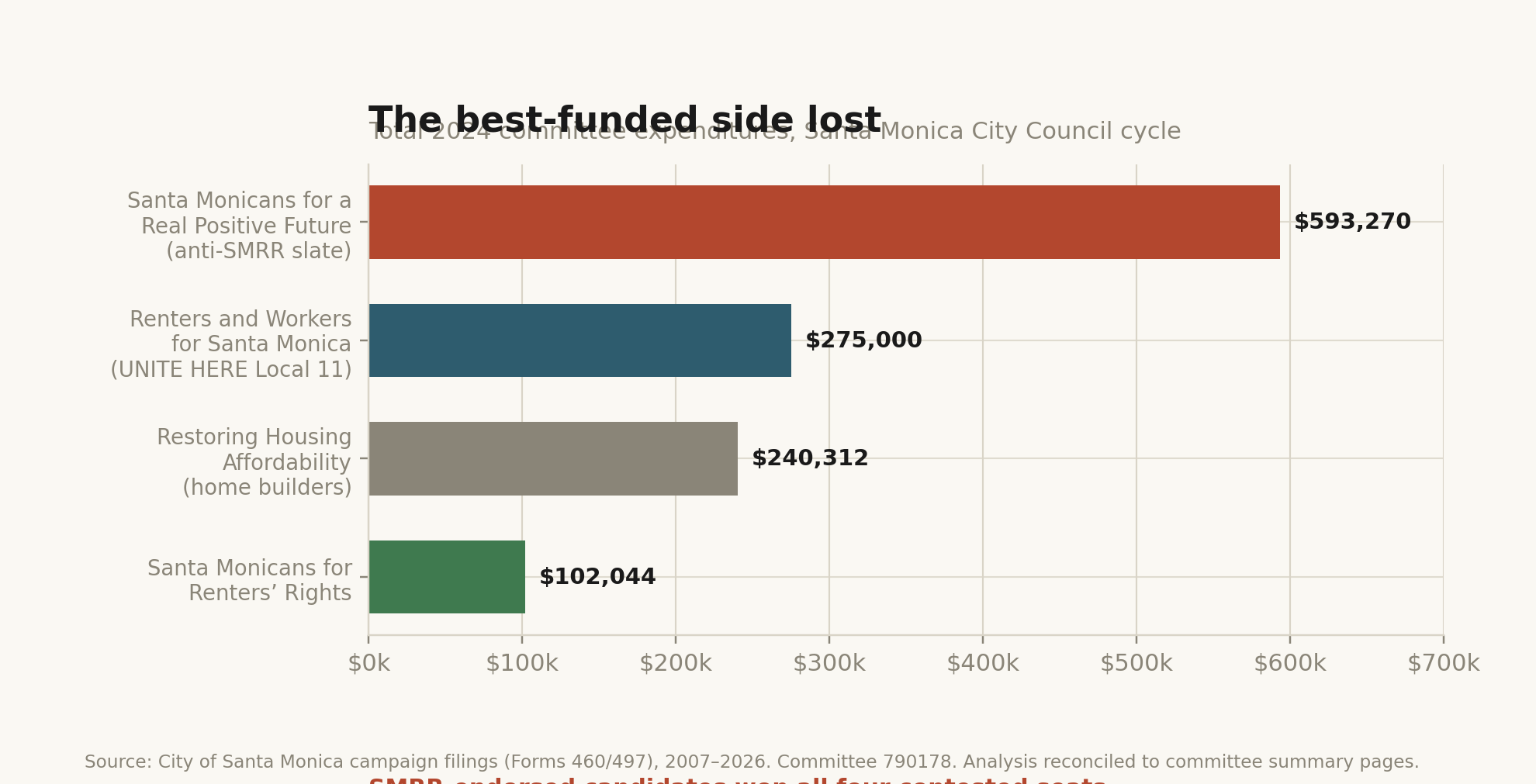
DV04
Committee spending in the 2024 Santa Monica council cycle. The committee formed to defeat SMRR's slate spent nearly six times what SMRR spent, and SMRR-endorsed candidates won all four contested seats.
Analysis of City of Santa Monica campaign filings.
Editorial note the home-builder committee's supported candidates cannot be determined from its filings. Do not caption it as backing either side.
SMRR-endorsed candidates won all four contested seats. The organization went from having lost three seats in 2020 to holding six of seven.
There are honorable explanations. The opposition slate carried its own liabilities and its own contradictions. Voters may have judged the fiscal and housing failures to be genuinely beyond local control, which in part they were. Money does not buy Santa Monica elections, and that is a fact worth celebrating rather than deploring.
But the pattern is difficult to square with a healthy accountability loop. The seats are allocated, in practice, by an endorsement decided at a convention where fifty-one members constitute a quorum and 117 ballots were cast in 2024. Membership requires dues paid before a cutoff set months in advance. There is no absentee voting. The organization that runs that convention is now funded, nine dollars in ten, by two people.
None of that is illegal, and none of it is hidden. It is the accumulated result of rules adopted for defensible reasons by people who were, at the time, trying to keep a landlord-funded opposition from packing their meetings.
That is the finding, and it is more serious than hypocrisy. Santa Monica does not lack elections. It lacks a mechanism by which a decade of governing failure becomes an electoral fact. The machinery works exactly as designed, and what it was designed to do — protect a tenant movement from capture — now insulates a governing establishment from consequence.
XI. What Happened to the Reform Generation
The reformers of the 1970s built a particular kind of machinery: not redistribution primarily, and not public ownership, but procedure. Disclosure, environmental review, comment periods, advisory commissions, elected boards, ballot initiatives, campaign finance reporting. The theory was elegant and, for a while, correct. Concentrated interests won because they operated in the dark and moved faster than the public could respond. Give citizens information and veto points, and the asymmetry corrects.
What the theory did not anticipate is that veto points are not neutral. They advantage whoever is organized, patient, and already present. In 1979 in Santa Monica that was tenants facing landlords. By 2005 it was incumbent residents facing people who did not live in the city and could not vote in it. And at every point in between it was citywide organizations rather than neighborhood ones — which is the structural fact underneath Pico’s lawsuit.
The 1980s and 1990s narrowed what local progressive coalitions could attempt. Federal retrenchment, the tax revolt, and declining union density took economic democracy as Derek Shearer had described it — public enterprise, worker ownership, municipal capital — off the agenda. What remained achievable was defensive. Santa Monica’s own record teaches the lesson efficiently: the living-wage law SMRR and its labor allies passed in 2001 was overturned by a business-backed referendum in 2002. Rent control survived. A rational organization draws a conclusion from that pair.
The state was eroding even that. The Ellis Act, passed in 1985 after litigation originating in Santa Monica, gave landlords a route out of the rental business; the city has lost 2,046 units to it. Costa-Hawkins mandated vacancy decontrol in 1995 over SMRR’s opposition. The share of controlled units still held by pre-1999 tenants fell to about one in five.
By the 2000s the movement was structurally an incumbent-protection operation — not because anyone chose that, but because the state had removed the tools for anything else and the remaining constituency was, by definition, the people already inside.
Then the ground moved again. Beginning around 2015 a new housing politics emerged whose premise was that scarcity, not landlord rapacity, drove housing costs — and that the procedural machinery of the reform era was the mechanism producing the scarcity. It claimed the same moral vocabulary while demanding the opposite policy. And it had something SMRR did not: the Legislature.
This is the transformation that matters, and it is not a story about hypocrisy. SMRR’s positions have been remarkably consistent for forty-seven years. It has always been for tenant protection and against large-scale development. What changed is that those commitments used to point the same direction and now point opposite ways. Protecting the tenants who are here means limiting what gets built. Limiting what gets built means fewer homes for the tenants who are not here yet.
There is no dishonesty in that. There is a constituency that stopped growing.
XII. Who Won, Who Paid, and Who Was Never in the Room
The winners are real and the gain should not be minimized. As of December 2024 Santa Monica had 27,668 rent-controlled units — roughly two-thirds of its multifamily stock, about fifty-eight percent of the city’s roughly 47,300 occupied households, and something near four-fifths of its rental homes. Tenants holding apartments since before 1999 pay a median of about $1,117 a month against $2,683 for market-rate controlled units — a gap of roughly $1,566 a month, more than $18,000 a year. For a retired person on a fixed income that is the difference between living in Santa Monica and not. Almost nowhere else in Southern California produced anything comparable.
But the word renter had quietly come to describe four different people, and SMRR spoke fluently for one of them. There is the long-tenured tenant paying a deeply protected rent. There is the newer tenant in a nominally controlled building whose unit reset to market when the last occupant left. There is the newcomer paying today’s price. And there is the person who would live in Santa Monica if a home existed. The first has an organization, a board, a hotline, and a council majority. The fourth has the California Legislature and nothing else.
Who benefits is more contested than the movement’s rhetoric allows, and the most direct evidence is Santa Monica’s own. A 1990 study in the Journal of the American Planning Association compared tenant surveys from 1979 and 1987 and found the ordinance had done much of what it promised: tenure lengthened, and lower-income tenants and the elderly benefited most. It also found that rent control had not halted the decline in the city’s Black and Latino households. The provision doing the protective work, the authors concluded, was vacancy control — the provision the state would abolish eight years later.
The wider literature is less flattering, though none of it is Santa Monica–specific. Economists examining how rent control’s benefits are distributed have generally found them to be regressive rather than progressive: because the gain accrues to length of tenancy rather than to need, wealthier long-tenured tenants tend to capture more of it than poorer ones. And the most-cited study in the field, Diamond, McQuade and Qian’s work on San Francisco, found that gains to protected tenants came partly at the expense of everyone not covered — renters in uncontrolled units and people who wanted to move to the city and could not. That is this article’s argument, reached independently and by different means.
Homeowners benefited too, without any explicit bargain. Slow growth and neighborhood preservation limited nearby change and helped preserve scarcity; Proposition 13 separately insulated long-tenured owners from current assessments. Santa Monica property would have appreciated regardless — it is coastal, small, and rich in amenities, and no local study isolates the value created by any particular policy. The defensible point is political rather than econometric: a movement founded against property power came to sustain a settlement protecting two forms of incumbency at once — controlled rents for tenants who stayed, and scarce, tax-advantaged property for owners who stayed.
The clearest institutional beneficiary is Community Corporation of Santa Monica, founded in 1982, which manages more than two thousand units and holds roughly sixty percent of the city’s publicly funded affordable stock, with about $199.5 million in assets. Scrutiny has centered on cost, not conduct: a Virginia Avenue rehabilitation ran to $802,875 per unit, escalating toward $937,500 amid a roughly $3 million overrun. SMRR co-chair Patricia Hoffman chairs its board — a governance overlap worth disclosing, with no evidence of enrichment and no ethics finding.
And there is a class of losers who appear in no accounting. Multifamily production in Santa Monica collapsed in the middle of the last decade: the city recorded 941 multifamily units in fiscal 2013 and 2014 together, 503 of them affordable, and then 478 units across the following four years — an average of about 119 a year, in a city that would shortly be told to plan for 8,895. By 2022 a new tenancy in a market-rate studio required an income near $115,000.
The people who did not move to Santa Monica are not in the city’s demographic data, because they are not in the city. They did not attend hearings, because they had no standing to. They are the teacher commuting from Palms, the nurse in Inglewood, the adult child of a rent-controlled tenant who could not find a unit in the neighborhood she grew up in.
This is what the reform-era machinery cannot see. Every safeguard the 1970s built allocates influence to people already present. There is no mechanism by which someone who would live in Santa Monica if housing existed can register that preference — and, Pico’s plaintiffs argue, only a limited mechanism by which people who do live there, in the wrong part of it, can register theirs.
XIII. The Best Case for SMRR
An honest accounting requires the strongest defense, and it is stronger than SMRR’s critics generally admit.
They were right about the landlords. The 1978 promise that Proposition 13 savings would reach renters was false. The conversions and demolitions were real.
The policy worked. Twenty-seven thousand households pay below-market rents in one of the most expensive coastal markets in the country. Whatever the distributional imperfections, that is a larger and more durable transfer to non-wealthy people than almost any American city achieved locally in the same period.
The money ran the other way for forty years. Every serious test of the capture thesis fails. Developer money funded SMRR’s opponents. Its largest donor spent his money on a tax. Its consultants worked below market.
It did not rule continuously, and it lost the fights that mattered most at the state level. The Ellis Act and Costa-Hawkins were imposed over its objection and did more to erode rent control than any local decision.
Its record on Latino representation is not empty. It endorsed and elected the first modern Latino councilmember and backed de la Torre through five school-board terms.
On at-large elections, its defense has legal support. An appellate court found the plaintiffs had not proved the system was adopted with discriminatory intent, and the California Supreme Court, while reviving the case, did not hold that Santa Monica violated the law.
And on SB 79, its stated objection is not frivolous. A law upzoning near transit, in a city where the transit-adjacent neighborhood is also the lower-income neighborhood, creates a real risk that the people displaced are the people the law claims to help. The Planning Commission’s warning was unanimous and grounded in the city’s own displacement analysis.
Does the article survive that defense? Mostly — and the places it survives are specific.
It survives on the numbers. Thirteen percent of a housing allocation permitted in three years, and a four-year stretch averaging 119 multifamily units a year in a city of ninety thousand, are policy outcomes rather than accidents.
It survives on July 14, but in a narrower form than it first appears. Displacement concern does explain the choice of R1 over R2 and R3 — that reasoning is on the record, it is coherent, staff supported it, and the one member who voted against it did so because she wanted the multi-unit parcels upzoned instead. What displacement concern does not explain is the exclusion itself. Upzoning was the price of a threshold that would exempt an entire zone until 2030. The council chose to pay that price on the one constituency rent control never needed to protect, and chose to pay it at all in order to defer a law written to house renters.
It survives on Pico — not as a claim that SMRR caused the neighborhood’s condition, which it plainly did not, but as a claim about how the organization treated a rival progressive claim once it arrived. A movement that had itself been told to wait its turn spent a decade defending, at considerable public expense, the electoral structure a minority community said was denying it a voice.
And it survives on the finances, which are a diagnosis rather than an accusation.
XIV. What the Record Establishes
Established. Santa Monica declared a state of fiscal distress in September 2025 with reserves down from $435.8 million to roughly $150 million, a projected $29.1 million structural deficit, and an unfunded pension liability of roughly $497 million. S&P downgraded the city’s lease revenue bonds in June 2024, and both Moody’s and Fitch moved to negative outlooks in the autumn of 2025. The city lost its zoning authority through a failure to certify a housing plan after the state identified specific deficiencies and gave it a second attempt. It has approved 6,449 units and has 471 under construction. In November 2024, an opposition slate backed by $593,270 against SMRR’s $102,044 lost all four contested seats. SMRR did not become a developer-financed organization; the money ran the other way for two decades. The 2020s filing wave was triggered by a state statute activated by a failure to certify a housing plan. SMRR’s small-donor base has collapsed and been replaced by two people. The Measure GS money was structured as loans, remains 99.6 percent outstanding, and the committee has not filed in three years. Santa Monica has permitted roughly thirteen percent of its current housing allocation in three years. The largest modern commercial entitlement wave came while SMRR lacked a working majority. On July 14, 2026, a SMRR-endorsed council majority voted 5–1 to direct staff to draft an ordinance upzoning single-family parcels in order to defer a state housing law until roughly 2030 — rejecting for want of a second a motion to upzone the neighborhood’s multi-unit parcels instead. The Belmar demolitions and the freeway routing were city decisions that destroyed a Black neighborhood, and the city has formally apologized for them.
Supported but not conclusively established. That WS Communities’ ability to file fourteen applications in eight months rested on an acquisition strategy built around clearing rent-controlled buildings. That Santa Monica’s housing plan was calibrated to minimize rezoning obligations. That SMRR’s decades of restrictive land-use policy contributed materially to the conditions producing state preemption.
Contested. Whether Santa Monica’s production record differs meaningfully from comparable coastal cities. How rent control’s benefits are distributed within Santa Monica by income and race — a question the city has never studied with unit-level data. Whether SB 79 would, on net, displace or protect Pico tenants. Whether at-large elections dilute Latino votes in Santa Monica — the question a court will take up on October 26.
Open. Whether the May 2023 settlement traded harassment enforcement for zoning relief. Whether the $386,040 in outstanding loans is legally a contribution. What the lenders holding Shekhter’s former portfolio wanted from the 2024 election. When Councilmember Zwick’s employment negotiations with the Housing Action Coalition began, which is the date section 87407 turns on and which no public record so far fixes.
Refuted. That developer money captured SMRR. That its founding consultants enriched themselves through it. That it quietly converted to a pro-development posture. That only $500 of real-estate money ever reached it. That it ruled without interruption for forty years. That it authored the 1980s commercial boom.
Not established, and it should be said plainly: that Santa Monica’s at-large system was adopted in 1946 for the purpose of excluding Latino voters. An appellate court examined that claim and rejected it. What the record supports is narrower and sufficient — that a structure adopted for other reasons came to have that effect, and that the organization it most benefited had every incentive not to look closely.
XV. What Would Actually Change This
Recommendations in stories like this tend toward the ceremonial. These are chosen because someone identifiable has the authority to act.
Make the endorsement legible. The most consequential political decision in Santa Monica each cycle is made by roughly a hundred people at a private meeting with no disclosure of attendance, vote totals, or recruitment. SMRR is a private association and cannot be compelled to open its convention. But the council can require that any organization whose endorsement is claimed on campaign literature disclose its membership count, quorum, and vote totals. Authority: council ordinance. Resistance: immediate and effective, since six of seven members hold the endorsement. Assessment: unlikely without a ballot measure. SMRR could also simply do it voluntarily, and the fact that it has not is itself informative.
Settle the voting-rights question on the merits, and publish the cost. Whatever the trial produces in October, Santa Monica’s voters are entitled to know what defending at-large elections has cost in fees and staff time across ten years, stated as a line item. Authority: City Manager. Cost: nominal. Resistance: modest, which is revealing.
Treat long-outstanding committee loans as contributions. A zero-interest loan to a committee with no assets, unrepaid after three years and undisclosed since, functions as a gift while escaping the reporting treatment of one. Authority: the FPPC by regulation, or the Legislature. Measurement: share of committee loans outstanding more than twenty-four months after an election. Assessment: achievable and narrow enough to pass.
Enforce termination requirements on delinquent committees. The Measure GS committee has not filed since May 2023 while carrying $386,040 in debt. Authority: the City Clerk as filing officer, and the FPPC. Cost: essentially zero.
Publish a permit series. A single authoritative table of housing units proposed, approved, permitted, and completed by year and type from 1979 forward. Nearly every argument in this story — and every argument SMRR and its critics have with each other — turns on numbers that currently require assembling three databases to approximate. Authority: City Manager. Resistance: minimal, which is itself the point.
Give the absent a procedural standing. No city has solved this. Regional housing allocation is the state’s crude answer. A better local one would require the city to publish, alongside every significant land-use decision, an estimate of the housing the decision forecloses and the income levels of households thereby excluded — a fiscal note for exclusion. It would bind no one. It would make the tradeoff visible at the moment it is made. Authority: council. Assessment: long-term organizing.
Publish an annual accountability report against stated goals. Santa Monica has a housing dashboard, which is genuinely good practice and should be credited. It has no equivalent for governance: a single annual document stating what the council committed to, what was delivered, what it cost, and what was missed — housing certification, reserve levels, litigation exposure, deferred maintenance, commercial vacancy — published before candidate filing closes. Authority: City Manager, or by ordinance. Resistance: substantial and revealing. Assessment: the cheapest available intervention on the accountability gap, and the one most likely to be resisted precisely because it would work.
Fund the reporting. Almost every unresolved question here — the roll calls, the settlement, the case disposition, the permit history — is answerable by a reporter with time and public records. Santa Monica once had several competing outlets covering city hall. That collapse is not incidental to how a city loses track of $386,040 and a fourteen-tower zoning fight in the same decade.
XVI. Three Dates
Santa Monica’s next ninety days contain the whole argument.
August 9. SMRR holds its annual convention at the Grant Elementary School auditorium at one o’clock. Members must appear in person; there are no mail ballots and no remote option, and to vote a member must have paid dues and joined before May 12 — a cutoff set three months out, which functions as a defense against exactly the kind of late recruitment that could change an outcome. In the notice announcing it, signed by Denny Zane and verified by a local news outlet, leadership warned members about “efforts by outside groups” to influence the endorsement, specifically naming supporters of SB 79.
The outside groups include Santa Monica Forward, co-founded in 2015 by Judy Abdo, a former SMRR-endorsed mayor, with former councilmembers Terry O’Day and Richard Bloom. The people SMRR is now defending its convention against are, in substantial part, people SMRR elected. The fragmentation is broader: this month the Santa Monica Democratic Club, SMRR’s closest institutional ally for four decades, failed to endorse any council candidate after two rounds of voting — reportedly the first such result in its history.
October 26. A Los Angeles Superior Court begins trial on whether Santa Monica’s method of electing its council unlawfully dilutes Latino votes. The case is ten years old. It has been won, reversed, revived by a unanimous state Supreme Court, and remanded. The city, in fiscal distress, is defending a system that has never been more consequential to the organization that six of seven councilmembers depend on.
November 3. The city votes.
Forty-seven years ago, tenants in a city of renters concluded that their local government did not represent them, organized, and took it. They were right, they won, and what they built has protected tens of thousands of people from a housing market that has ruined lives everywhere around it. That achievement is permanent and it belongs to them.
In August, something on the order of the 117 who voted last time will meet in that same elementary school auditorium and decide who governs a city of ninety thousand. Their organization is funded, nine dollars in ten, by two people. The council they select has just voted to add housing to the neighborhoods of people who own their homes, in order to keep it out of the neighborhoods of people who rent, in order to defer until 2030 a state law that exists because cities like theirs did not build. And ten weeks later a court will hear the argument that the machinery producing all of this has never fully counted the neighborhood the city bulldozed twice before the movement was born.
Every one of those decisions was made in public, by people we elected, under rules that were published. Nothing was hidden from us. It was simply never the question any of us thought to ask.
We had one more chance to ask it, and it came and went nine days ago.
Coda: The Same Evening
The SB 79 exclusion was not the only housing decision the Santa Monica City Council made on July 14. It was one of five land-use and revenue decisions the council took that night, across a regular meeting and a special one gaveled in at the same moment, and they are worth reading together.
Item 12.B was the SB 79 exclusion: defer the state’s transit-density law on five qualifying zones until roughly 2030, and raise development standards on multi-unit parcels near the Expo/Bundy station.
Item 12.A, heard immediately before it, did the opposite — for land the city owns. It amended the Downtown Community Plan and the zoning ordinance to increase the development potential of city-owned sites downtown and in the Gateway Master Plan area — the downtown station, the Sears site, the Pierside Hotel — expressly to implement the Realignment Plan, the city’s response to its own fiscal emergency. The new standard is 130 feet and a 5.0 floor-area ratio, and the increase runs to non-residential projects: housing already carried the higher entitlement, and the amendment brings commercial development up to parity with it. It passed 5–0. Dan Hall recused himself, his home being within a thousand feet of one of the parcels.
Item 11.B was the rent-control package: three charter amendments sent to the November 3 ballot.
Item 11.A, immediately before it, certified a citizens’ initiative for the same ballot: a $495 annual parcel tax on every taxable property in Santa Monica, to fund the school district — whose enrollment has fallen to about 8,526.

Santa Monica City Hall, seen across the Civic Center fountain, in March 2025.
Photograph Jengod, CC BY-SA 4.0 International, via Wikimedia Commons

And at a special meeting gaveled in alongside the regular one but not reached until past ten o’clock, a separate item asked the council to begin closing a tax loophole — a request that turns out to contain this entire story in miniature.
Santa Monica charges a fifteen percent transient occupancy tax on hotel rooms. Stays longer than thirty days are exempt, for the full duration. That threshold is not arbitrary and it is not a giveaway. Thirty days is the line California law draws between a visitor and a resident; past it, an occupant begins acquiring tenancy rights. The exemption exists because people who live in hotels are not tourists, and taxing their housing as though it were a vacation would be indefensible. It is, in origin, a tenant protection.
Working with organizations preparing for the 2028 Olympic Games, city staff realized that corporate room blocks booked for the Games will cross that same threshold. A single hundred-room block at $500 a night for forty-five days would escape roughly $337,500 in tax — by qualifying, on paper, as residents.
Because the current rate was set by voters in 2022, fixing it requires going back to the ballot. Staff proposed returning on July 28 to qualify a measure for November, and noted that it would consult the city’s hotel operators while drafting the language.
A rule written to protect people who live in hotels, being used by corporations that do not. The city discovering it only because a global event made the number large enough to notice. And the remedy requiring a vote of the same electorate that has spent forty-seven years approving the protections, one sympathetic case at a time.
Nobody designed that. It accumulated.
Read as a set, the evening has a logic that no individual vote reveals. Santa Monica will add development capacity where the city itself owns the land and needs the revenue. It will defer the development capacity the state requires on land owned by others near transit. It will ask voters to make existing tenancies more secure, and to tax themselves $495 a parcel for schools their children are leaving. And it will ask them, separately, to stop a tenant protection from being claimed by an Olympic hotel block.
Build where we profit. Delay what we are told. Protect who is already here. Ask the people who stayed to pay for what the shrinking left behind. And patch the rules only when the loss becomes large enough to appear in a budget forecast.
None of those three positions is indefensible. Together they describe a city governing for the people and the balance sheet it already has.
The rent-control package is the part that will reach voters directly, and it is broader than early coverage suggested. Three passed together, 6–0: a state-required environmental finding, a package of administrative updates to the Rent Control Board paired with a reaffirmation of the city’s just-cause eviction laws, and a prohibition on evicting tenants over small rental debts. A fourth measure passed 4–2, with Lana Negrete and Barry Snell opposed. Jesse Zwick recused himself again, citing his employment with a housing-advocacy organization.
The proposals came out of a January directive that councilmembers said was prompted by federal immigration enforcement in the region. Dan Hall asked his colleagues to remember that context — that raids had left households where “primary tenants were taken into custody by federal immigration enforcement, leaving family members … in pretty rough straits.” The nonpayment measure responds to a documented problem: roughly seventy-five percent of eviction lawsuits reported to the city attorney since 2024 were for nonpayment, at a median of about $6,000.
These are real harms, and the response to them is defensible. A tenant should not lose a home over a debt smaller than a month’s rent. A household should not be destroyed twice — once by a federal raid and again by an unlawful detainer.
The fourth measure is where the story of the last forty-seven years arrives at its logical end.
It would bar landlords from evicting tenants who move additional occupants into a unit, and would allow certain occupants to remain after the original tenant leaves. It would also, per the staff report, extend just-cause eviction protections to single-unit dwellings and condominiums and modify the requirements for good-faith owner move-in evictions from units that are not rent-controlled — a reach beyond the rent-controlled stock into the rest of the city’s rental housing. Negrete pressed the Chief Deputy City Attorney, Romy Ganschow, on whether that could produce what critics call perpetual tenancy — whether a unit could pass from occupant to occupant indefinitely, never returning to the market.
“That could happen under this regulation,” Ganschow answered. “It wouldn’t preclude that.” She qualified it in the next breath, and the qualification is real: the provision governs written rental agreements, most tenancies have none and are already unrestricted, and a landlord keeps the right to remove a nuisance tenant under one of ten or eleven other grounds. The answer stands anyway. Asked whether a unit could pass from occupant to occupant without end, the city’s lawyer did not say no.
There, in a city attorney’s careful answer at a Tuesday council meeting, is the closed city, described by the city itself. A protected unit that can be inherited without limit is a protected unit that never becomes available to anyone standing outside. Every such unit is a household saved and a door closed, and both halves are permanent.
Mayor Caroline Torosis defended the measure with a case that is difficult to argue against and should not be argued against lightly. An elderly parent dies. The adult child who lived there as caretaker is not on the lease. “We’re talking about someone’s pocketbook versus … a roof over someone’s head and an exacerbating homeless crisis.” She is describing a real person, and on the facts of that case she is right.
The two dissenters were not landlords. Snell is a renter and a business owner. Negrete says she lives in a rent-controlled building herself, and her objection was about the people the measure does not appear in: the small owners who told her they had been blindsided, and who might conclude, as she put it, “God, I can’t handle this anymore. I’m going to put it up for sale.” Whether that fear is warranted is contested — the Apartment Association of Greater Los Angeles called the occupancy language vague and ripe for abuse, and it is an interested party.
Ellis Raskin, carrying the motion, made the case for deference: the Rent Control Board’s elected experts had worked on this for six months, and in any event, “we’re not making law tonight … it’s the electorate that decides.”
The council then turned to who would write the ballot arguments. Hall took the administrative package, Torosis the nonpayment protection, Raskin the occupancy measure. Then the mayor asked the question the process requires her to ask.
“Does anyone want to file an argument against?”
Nobody answered.
She had asked it once already that evening. Two hours earlier, on the parcel tax, a colleague had raised a point of order to remind her: “Do you have to request if any council member is interested in writing against the measure?” She asked. “Seeing none,” she said, and moved on. On a citizens’ initiative the proponents write the argument in favor, so “against” was the only argument a councilmember could have written at all.
The vote to authorize the arguments was 6–0. No member filed an argument against any measure.
So the electorate will decide, in November, between a written case for, signed by three of the people who wrote the measures, and whatever case against a private citizen troubles to file by the twenty-eighth of July. On the same ballot, in the same city, in the same election that follows a voting-rights trial by eight days.
This is the thing worth understanding about our city, and it is not hypocrisy, and it is not a scandal.
On one evening in July, a council we elected voted to postpone until 2030 a state law that would add homes near transit, and to ask us to make existing tenancies more secure and more heritable. Both votes protect people who are already here. Both were cast for reasons their authors could defend, and largely did. Nobody in that room was lying, and nobody was bought.
The city did not close itself on purpose. It closed one sympathetic case at a time — most decided by a council, some recommended by a Rent Board, and three of them, in November, by us. And nearly every one of those cases was right. The elderly parent’s caretaker should not be evicted. The household emptied by an immigration raid should not lose the apartment too. No one should be put on the street over six thousand dollars. Each of those is true, and each of them is ours, and we would vote for them again.
What we have never had to do is add them up.
That is the failure, and it is a failure of design rather than of character. We built a system that asks us, over and over, whether to protect the person in front of us. It has never once asked what we owe the person who is not in the room — the daughter who moved to Mar Vista, the teacher driving in from Palms, the family that would have moved here in 2012 if anything had been available to move into.
In November we will be asked again. Three of those questions will be on our ballot. Every one of them will carry an argument in favor signed by a member of our council. None will carry one signed against — not because the case could not be made, but because when the question was put, on the record, twice, nobody spoke.
We should vote our conscience on each of them. We should also, finally, ask the question the ballot never will: not whether this one is right, but what all of them together have made — and whether we still recognize it as the city we thought we were protecting.
Reporting for this article included analysis of all City of Santa Monica campaign finance filings from 2007 through June 2026 — approximately 45,000 contribution records and 17,000 expenditure records — obtained in bulk from the city’s public electronic filing portal and reconciled against each committee’s summary statements. Court records, city complaints, state housing agency correspondence, council and planning commission agendas, budget documents, and contemporaneous local reporting were also reviewed. Multifamily production figures for the 2010s are drawn from the city’s annual Proposition R reports as summarized by Frank Gruber; we have not yet re-derived them directly from those reports, and Gruber is also this article’s most-quoted critic of SMRR. The distributional findings on rent control are drawn from the published economics literature rather than from any Santa Monica–specific dataset, and are characterized as such.
A note on right of reply, and on what this article does not know
The people and organisations named in this article were not contacted for comment before it was published. That is a departure from normal practice and from our own stated editorial standards, and readers are entitled to weigh the reporting accordingly.
Not contacted: SMRR; Michael Soloff; Patricia Hoffman; Denny Zane; the seven current councilmembers — Caroline Torosis, Lana Negrete, Ellis Raskin, Barry Snell, Natalya Zernitskaya, Dan Hall and Jesse Zwick; Oscar de la Torre and the Pico Neighborhood Association; Community Corporation of Santa Monica; the City Attorney; and the successor entities to WS Communities. Neil Shekhter died in 2024 and could not respond to matters concerning him.
Any response will be carried in full and without condition, at oursantamonica@gmail.com. Corrections are permanent, appended to the article and listed in the corrections index; they are never quietly edited into the text.
Two specific limits on what is established here:
The Adam Shekhter court file has not been obtained. The account of the 2018 complaint and the 2022 diversions is drawn from the City of Santa Monica’s own press releases of January 10, 2019 and August 31, 2022 and from contemporaneous local reporting. Adam Shekhter was not convicted of anything; pretrial diversion is not an admission of guilt. We have not confirmed from the court record whether the diversion was completed and the charges dismissed, and the absence of reporting on a dismissal is not evidence that none occurred.
All three roll calls this article once listed as unreconstructed now carry names, but they do not all rest on the same quality of record, and the difference matters.
The 2017 Downtown Community Plan vote and the 2015 boulevard downzoning are drawn from the City Council’s adopted minutes — the formal record, approved by the body that took the votes.
The December 2024 agreements with Hollywood Community Housing Corporation are not. That item passed 6–0 on December 17, 2024, with Barry Snell absent, and the source is the video record of the meeting, because the adopted minutes for that date have not been published. A transcript of proceedings is good evidence of what was said and how members voted; it is not the document the council later certifies as accurate. Where this article reports that vote, it is reporting the video. If the minutes, when adopted, differ, the minutes govern and this article will be corrected.
Passages concerning the Pico Youth and Family Center, the criminal matters involving Adam Shekhter and affiliated entities, the May 2023 settlement, and the outstanding Measure GS loans have not been reviewed by counsel.
Three dates
-
in 18 days
SMRR annual convention
Grant Elementary auditorium, 1pm. In-person voting only.
-
in 96 days
CVRA trial begins
Pico Neighborhood Assn. v. City of Santa Monica, LA Superior Court.
-
in 104 days
Municipal election
Council seats plus three rent-control charter amendments and a $495 parcel tax.
Relative times are calculated at build time (July 22, 2026) and update when the site is rebuilt.
Sources & method
- City of Santa Monica campaign finance filings, 2007 - June 2026 (bulk transaction export) campaign finance
- Form 460, committee 790178 (Santa Monicans for Renters' Rights) campaign finance
- Form 460 Schedule B1, committee 1446209 (Measure GS support committee) campaign finance
- Santa Monica City Council adopted minutes, 25 July 2017 (Downtown Community Plan) council record
- City of Santa Monica press release, 18 December 2024 (Wilshire lots affordable housing) city document
- Santa Monica City Council agenda 1499, 14 July 2026 (items 11.A, 11.B, 12.A, 12.B) council record
- Santa Monica City Council special meeting agenda 1512, 14 July 2026 council record
- City of Santa Monica press release, 10 January 2019 (misdemeanour complaint) city document
- City of Santa Monica press release, 31 August 2022 (pretrial diversion) city document
- City of Santa Monica housing dashboard, July 2026 city document
- City of Santa Monica Pension Overview city document
- Santa Monica Rent Control Board, median rent data city document
- California HCD correspondence on the Santa Monica housing element, from August 2021 state document
- Pico Neighborhood Assn. v. City of Santa Monica (California Supreme Court, 2023) court record
- Fitch Ratings report, October 2025 (outstanding abuse claims) news
- City of Santa Monica annual Proposition R reports, as summarised by Frank Gruber city document
- Santa Monica City Council adopted minutes, 14 and 15 April 2015 (draft zoning ordinance and LUCE amendments) council record
- FPPC advice letter A-25-153 to the Santa Monica interim city attorney, 8 December 2025 state document
- Santa Monica City Council meeting video, 17 December 2024 (item 11.A) - adopted minutes not yet published council record
The campaign-finance analysis behind this article is reproducible. Download the datasets and read the method note →
Republish
Licensed CC BY-ND 4.0 — republishable with attribution and canonical link. Copy the article as clean, self-contained HTML with attribution and a canonical link back to this page.
Found an error?
Corrections are permanent here: they are appended to the article, listed in the site-wide corrections index, and never quietly edited into the text. If something in this piece is wrong, tell us and show us — oursantamonica@gmail.com.